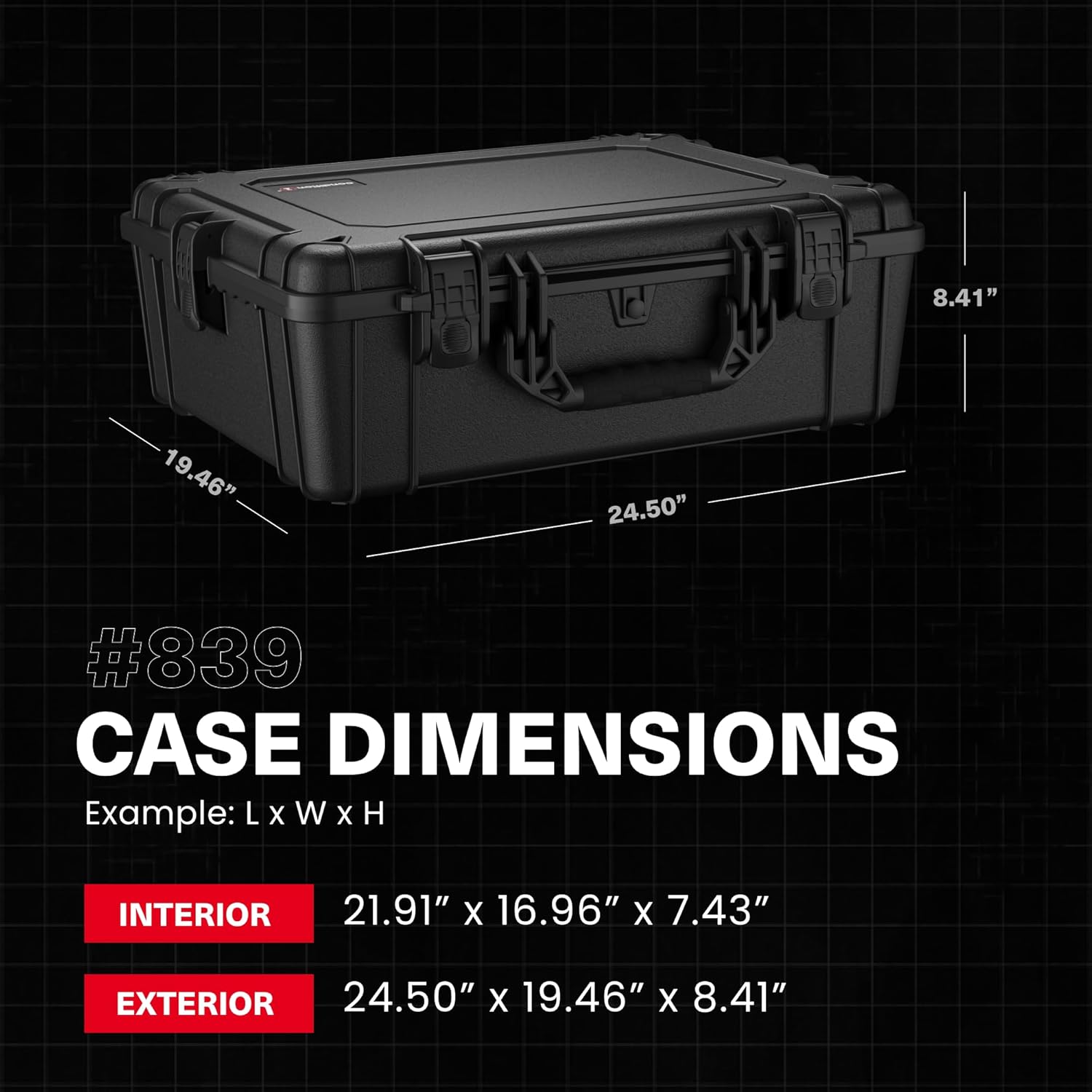
If you’ve ever shipped a drone kit across a film set, checked a mirrorless camera rig at an airport, or watched a colleague’s bag get rained on during a load-in, you already understand the core premise of a hard case: the padded shell you carry your gear in determines whether your equipment arrives intact or doesn’t. IP67 is the protection rating you’ll see on serious cases — it’s an international standard (IEC 60529) that certifies a product is fully dust-tight and can survive submersion in up to one meter of water for thirty minutes. Cases carrying that rating have been independently verified, not just marketed as “weather-resistant.” The question this article answers is whether the budget-tier options — specifically Condition 1 and Monoprice Weatherproof cases, both priced in the $50–$150 range — are genuinely IP67-capable tools for working operators, or whether they’re a false economy that puts mission-critical gear at risk. By the end, you’ll have a clear decision framework for exactly when these cases earn their spot in your workflow and when you should step up.
What You’re Actually Getting in the Budget IP67 Tier
Let’s be honest about the category first. The $50–$150 hard case market is crowded, and most of the products in it are variations on a small number of OEM shells manufactured in bulk and sold under different brand labels. Condition 1 and Monoprice are two of the more consistently reviewed names in this tier, and they represent slightly different value propositions worth distinguishing.
Condition 1 cases — available in a range of sizes from compact pistol-case dimensions up to larger rolling cases — are marketed explicitly around military-adjacent aesthetic and waterproofing claims. Their spec sheets rate the latching hardware and gasket seal system to IP67 standards. Owners across aggregated reviews on platforms like B&H Photo Video’s customer review section consistently note that the latches feel more substantial than similarly priced alternatives, and that the cases arrive with pre-cut pick-and-pluck foam (small cubes of foam you remove to custom-fit your gear) installed. The caveat reviewers raise most often: the handle and hinge hardware feels lighter than Pelican equivalent builds, and long-term durability under repeated airline handling is a common open question.
Monoprice Weatherproof Hard Cases take a more utilitarian approach. Monoprice’s product documentation describes these cases as IP67-rated, and they’re typically sold with layered foam inserts. The brand’s value positioning — Monoprice built its reputation selling cables and AV accessories at stripped-down margins — carries over here. Reviewers at PopPhoto and community voices cited in Outdoor Life’s gear roundup coverage note that Monoprice cases are credible short-run protection tools, particularly for hobbyists who need a single case to protect a mid-range mirrorless kit or a drone like a DJI Mini series. What they lack is the brand ecosystem: there are no manufacturer-supported custom foam cut options, no warranty support infrastructure comparable to Pelican’s lifetime guarantee, and no rack-mount or airline-carry-on specific sizing variants designed around TSA or IATA (International Air Transport Association) dimension rules.
By the numbers:
| Spec | Condition 1 (mid-size) | Monoprice Weatherproof (mid-size) | Pelican 1510 Carry-On |
|---|---|---|---|
| Waterproof rating | IP67 (manufacturer-stated) | IP67 (manufacturer-stated) | IP67 (manufacturer-tested, MIL-C-4150J) |
| Warranty | 1 year limited | 1 year limited | Lifetime guarantee |
| Street price range | $60–$130 | $50–$120 | $190–$230 |
| Airline carry-on compliant | Size-dependent; no guaranteed fit | Size-dependent; no guaranteed fit | Designed to FAA/IATA overhead bin spec |
The numbers clarify the tradeoff immediately: you’re saving $80–$150 upfront, and you’re accepting shorter warranty coverage, lighter manufacturing tolerances, and no airline-dimension guarantee. Whether that tradeoff is rational depends entirely on what’s inside the case and how it’s traveling.
The Three Scenarios Where Budget IP67 Cases Make Rational Sense
Here’s where the decision frame gets practical. These cases are not universally wrong — they’re wrong in specific contexts. In others, they are exactly the right tool.
Scenario 1: Ground-transport-only use with gear valued under $1,500.
If your workflow is car-to-job-site, you’re not checking bags at an airport, and the gear inside is a sub-$1,500 kit — a mirrorless body and one lens, a single DJI Mini 4 Pro drone, a set of wireless microphones — a Condition 1 or Monoprice case is a rational buy. The IP67 seal protects against rain, dust, and a dropped case in a puddle. The price delta versus a Pelican 1510 is real money. B&H Photo Video’s Explora buying guide for hard cases notes that the core value of premium cases is their verified manufacturing consistency and airline-specific engineering — neither of which matters if you’re driving to location. Owners in Outdoor Photographer’s reader forums consistently report years of ground-transport use from budget IP67 cases without seal failures.
Scenario 2: Backup or secondary case for a modular kit.
Working operators often run a primary Pelican or SKB case for the most critical components and need secondary cases for accessories — batteries, cables, spare media cards, monitor arms. A Condition 1 case in a medium size is a credible home for accessories that are replaceable but still shouldn’t get wet or dusty. The cost math is simple: buying three Condition 1 cases at $80 each versus three Pelican 1510 cases at $220 each represents a $420 savings on the accessory tier. That money is better spent on the primary case for your most expensive asset.
Scenario 3: First serious protection kit for a hobbyist building workflow habits.
If you’re a photographer or videographer who just stepped up to a Sony a7 IV or similar mid-tier mirrorless system and you’ve been transporting it in a padded bag — not a sealed hard case — any IP67 hard case is a significant upgrade. Monoprice Weatherproof cases, in particular, get mentioned consistently in PopPhoto’s budget gear coverage as an accessible entry point that teaches you how hard-case workflows function: foam customization, pressure-equalization valves (the small button or valve on the case that equalizes air pressure when you open the lid in different altitudes or temperatures), and the discipline of properly seating the gasket seal on close. Starting here and upgrading later is entirely rational.
The Four Scenarios Where You Should Not Compromise
The decision to step up isn’t about status. It’s about loss exposure. Here’s when the budget tier is the wrong call.
Any gear valued over $3,000 going on an aircraft. The moment you’re checking a $5,000 cinema lens, a RED Komodo body, or a set of wireless IEM (in-ear monitor) transmitters at an airline counter, the case protecting them needs to meet a higher standard. Airline baggage handling subjects cases to compressive loads, drops from conveyor heights, and exposure to cargo hold humidity that ground transport doesn’t replicate. Pelican’s published MIL-SPEC testing documentation — cited in B&H Photo Video’s Explora case buying guide — covers exactly these conditions. Budget cases are not tested against this specification. The $150 you save on the case is not a rational trade against a $5,000 insurance deductible or an uninsured loss.
Rental house or production company fleet purchasing. If you’re sourcing five, ten, or twenty cases for a rental inventory or broadcast studio, per-unit savings on budget cases compound — but so does per-unit failure risk. Outdoor Life’s coverage of production kit sourcing notes that rental operations prioritize warranty coverage and stackability consistency over unit cost. A cracked latch on a Condition 1 case six months into rental use is a customer-relations problem. Pelican’s lifetime guarantee transfers to new owners and is honored without purchase proof — a structural advantage that no budget-tier manufacturer currently matches.
Military, government, or aerospace contractor deployments. If your gear contract specifies MIL-SPEC (military specification) case ratings — which is common for AV and communications equipment contracts with federal agencies — neither Condition 1 nor Monoprice cases qualify. MIL-C-4150J and MIL-STD-810 certifications require third-party testing documentation that budget manufacturers do not provide. Using non-certified cases on a contract that requires certified cases is a compliance failure, not just a product choice.
Any situation where foam insert precision is mission-critical. Custom-cut foam — either manufacturer die-cut foam designed for specific gear models or professionally cut replacement foam — is the standard in serious production workflows because it prevents gear from shifting inside the case under impact. Condition 1’s pick-and-pluck foam is functional for casual use, but operators who’ve sourced replacement laser-cut foam for SKB iSeries or Pelican cases consistently report that the dimensional tolerance of budget case interiors varies enough to make precision foam fitting unreliable. If your gear needs to arrive oriented exactly correctly — a broadcast camera body with a mounted lens, a calibrated drone with attached sensors — precision foam matters, and the budget tier doesn’t reliably support it.
The “If X, Then Y” Decision Rule
If you’ve read this far, here’s the decision framework distilled:
If your gear value is under $1,500 and you’re ground-transporting only, a Condition 1 or Monoprice Weatherproof case is a smart, rational buy. Protect your investment, build the workflow habit, and reinvest the savings.
If your gear value is $1,500–$3,000 and you’re occasionally flying domestic, consider whether the trip frequency and gear replacement cost justifies stepping up to a Nanuk 935 or SKB iSeries 3i-2011 in the $150–$300 range — cases that offer IP67 certification with more rigorous manufacturing standards and better warranty coverage, as reviewed in B&H Photo Video’s Explora buying guides.
If your gear value exceeds $3,000 or you’re checking bags internationally, the Pelican 1510, Pelican Air 1615, or equivalent airline-dimensioned hard case is not optional. The math on loss exposure versus case cost resolves clearly at this level.
If you’re purchasing for a fleet, a rental operation, or a government contract, budget cases are off the table regardless of gear value. Consistency, warranty infrastructure, and certification documentation are structural requirements, not preferences.
The budget IP67 tier exists because there’s a real, legitimate use case it serves. Condition 1 and Monoprice cases aren’t fraudulent products — they’re correctly priced tools for a specific set of conditions. Knowing which conditions those are is exactly the kind of decision intuition you build in your first year or two of running serious kit. The case is never the expensive part. What’s inside it is.