If you’ve spent real money on a drone — say, a DJI Mavic 3 Pro or an Inspire 2 — you already know that the aircraft itself is only part of the investment. Add the controller, extra batteries (which airlines regulate separately as lithium-ion devices), ND filters (neutral-density glass that reduces light entering the lens), spare props, and a charging hub, and you’re easily looking at a $3,000–$15,000 kit spread across a backpack and a soft bag. A hard case is a rigid-shell protective enclosure — typically made from polycarbonate or high-density polyethylene — designed to absorb impact, seal out water and dust, and survive the checked-baggage carousel or the back of a work truck. The rating standard you’ll see most often is IP67: “Ingress Protection” level 6 (dust-tight) and level 7 (submersible to one meter for thirty minutes). This article walks you through which hard cases actually fit which DJI kits, how airline dimension rules affect your choice, and the real tradeoffs between carry-on and checked configurations — so you can make a confident call before your next job ships.
Why IP67 Matters More Than You Think for Drone Gear
Drone operators talk a lot about crash protection, but water and dust are the more likely culprits in day-to-day kit damage. Sand in a gimbal motor, moisture in a battery connector, condensation inside a controller — these failures are quiet, cumulative, and expensive. An IP67-rated enclosure is dust-tight (no ingress under any tested condition) and water-resistant to one-meter submersion for thirty minutes. That doesn’t mean you should submerge your Inspire 3; it means that a rain delay on a film set, a dock-side shoot, or a dusty desert location won’t compromise your foam seal.
Here’s the distinction worth locking in early: IP67 is a seal rating, not a structural rating. A case can be IP67-certified and still crack if a baggage handler drops it at the wrong angle. The structural story is told by a second standard — MIL-STD-810G (a U.S. military durability test protocol covering shock, vibration, altitude, and temperature) — which the best cases carry alongside their IP rating. Pelican, SKB iSeries, and Nanuk all publish MIL-SPEC compliance documentation; Apache and Seahorse cases at the entry tier typically cite IP67 without the military shock spec.
Operators in long-run reviews consistently note that the pressure-equalization valve (a small one-way port that prevents vacuum lock at altitude) is the feature that separates a truly travel-ready case from a waterproof box that’s a nightmare to open after a flight. Every Pelican Air, every SKB iSeries, and every Nanuk ships with one. Budget-tier Apache cases do not.
Matching Your DJI Kit to the Right Case Size
This is where most buyers lose time: they buy a case, then discover their folded drone with props attached doesn’t fit, or their battery bank pushes the lid open by 3mm and breaks the seal. Below is a working dimension framework based on published DJI spec sheets and manufacturer case interior dimensions.
By the Numbers — DJI Kit Folded Footprints vs. Case Interior Minimums
| DJI Aircraft (folded) | Approx. folded dims (L × W × H) | Recommended interior min. | Suggested case tier |
|---|---|---|---|
| Mini 4 Pro | 148 × 90 × 62 mm | 16” × 12” × 6” interior | Pelican 1450 / Nanuk 920 |
| Air 3 | 207 × 100 × 91 mm | 18” × 13” × 7” interior | Pelican 1510 / SKB 3i-1813 |
| Mavic 3 Pro | 221 × 96 × 90 mm | 20” × 14” × 8” interior | Pelican 1510 / Nanuk 935 |
| Inspire 2 (arms folded) | 422 × 295 × 217 mm | 26” × 18” × 14” interior | Pelican 1650 / SKB 3i-2918 |
| Inspire 3 | 430 × 420 × 223 mm | 28” × 22” × 14” interior | Pelican 1700 / SKB 3i-3213 |
Dimensions sourced from DJI official product specification pages and SKB/Pelican published interior measurement documentation. Always verify against the manufacturer’s current spec sheet before purchasing — DJI revises hardware between production runs.
The critical variable that dimension charts don’t show you is battery stack height. Most operators running a Mavic 3 Pro on a commercial job carry three to six Intelligent Flight Batteries. Each battery is roughly 77 × 55 × 38 mm. Stack three in a foam cutout layer above the aircraft and you’re adding nearly five inches of height. That’s the difference between a Pelican 1510 (which fits in the overhead bin) and a Pelican 1560 (which doesn’t). Know your battery count before you spec your case.
Carry-On vs. Checked: The Airline Dimension Problem
If you fly commercial with any regularity, you already know the FAA and IATA (International Air Transport Association — the global airline standards body) rules around lithium batteries: spare batteries must travel in carry-on, not checked bags. That single regulation drives most of your case architecture decisions, because it means your battery count determines whether you can consolidate everything into one carry-on or must split the kit.
The carry-on ceiling for most U.S. domestic airlines is 22” × 14” × 9” (total linear inches: 45”). The Pelican 1510 Carry-On clears this at 22” × 13.8” × 9” exterior — it’s spec-engineered to that limit. The Nanuk 935 at 20.5” × 11.3” × 7.5” exterior fits with room, though its interior is shallower and better suited to a Mavic 3 Pro body without a full battery suite. B&H Photo Video Explora’s travel-with-drones overview notes that overhead bin enforcement has tightened noticeably on regional carriers since 2024, and cases that technically meet the size limit may still be gate-checked on smaller aircraft.
Here’s what you should consider if you’re flying a Mavic 3 Pro kit to a commercial job: Run a Pelican 1510 as your carry-on with the aircraft, controller, and three batteries in foam. Check a second, larger Pelican (1600 series) with your ground station, filters, and accessories — none of which trigger the lithium battery restriction. Operators on long-haul international routes, per reviews aggregated at thedronegirl.com, commonly run this exact split-case workflow.
Here’s what you should consider if you’re flying an Inspire 2 or Inspire 3 rig: You’re in checked territory for the aircraft regardless. The TB50/TB51 batteries for the Inspire line are high-capacity and large enough that most operators ship the aircraft in a Pelican 1650 or Pelican 1700 as checked baggage, carry on the batteries in a dedicated Pelican 1510 or SKB 3i-1813 lined with battery-safe foam, and treat the carry-on case as a secondary priority. The Outdoor Photographer field guide to protective cases confirms this is the standard approach for professional Inspire operators, noting that the aircraft case often travels as oversized checked luggage with fragile stickers and direct handoffs at the ticket counter.
Case-by-Case Breakdown: What Fits What
Pelican 1510 Carry-On — The default starting point for Mavic 3 Pro and Air 3 operators. Interior: 19.75” × 11” × 7.6”. Manufacturer-rated IP67, MIL-STD-810F tested per Pelican’s product documentation. Fits a Mavic 3 Pro (folded) plus two to three batteries in custom-cut or pick-n-pluck foam. Operators consistently note the press-and-pull latches survive hard airline use; the main complaint across aggregated reviews is that factory foam requires significant trimming time for a tight drone fit. Worth budgeting an afternoon for the custom cutout or ordering a pre-cut insert from a third-party supplier.
Pelican Air 1615 — If you’re running a two-drone kit (say, an Air 3 as a B-camera and a Mavic 3 Pro as primary), this is where the conversation starts. Interior: 21.8” × 13” × 8.9”. Pelican Air cases use a thinner-wall HPX2 polymer that cuts weight by roughly 40% versus the classic Pelican line, per Pelican’s published materials. Still IP67, still MIL-SPEC compliant. Reviewers at B&H Explora call it the sweet spot for operators who need checked-bag volume without checked-bag weight penalties.
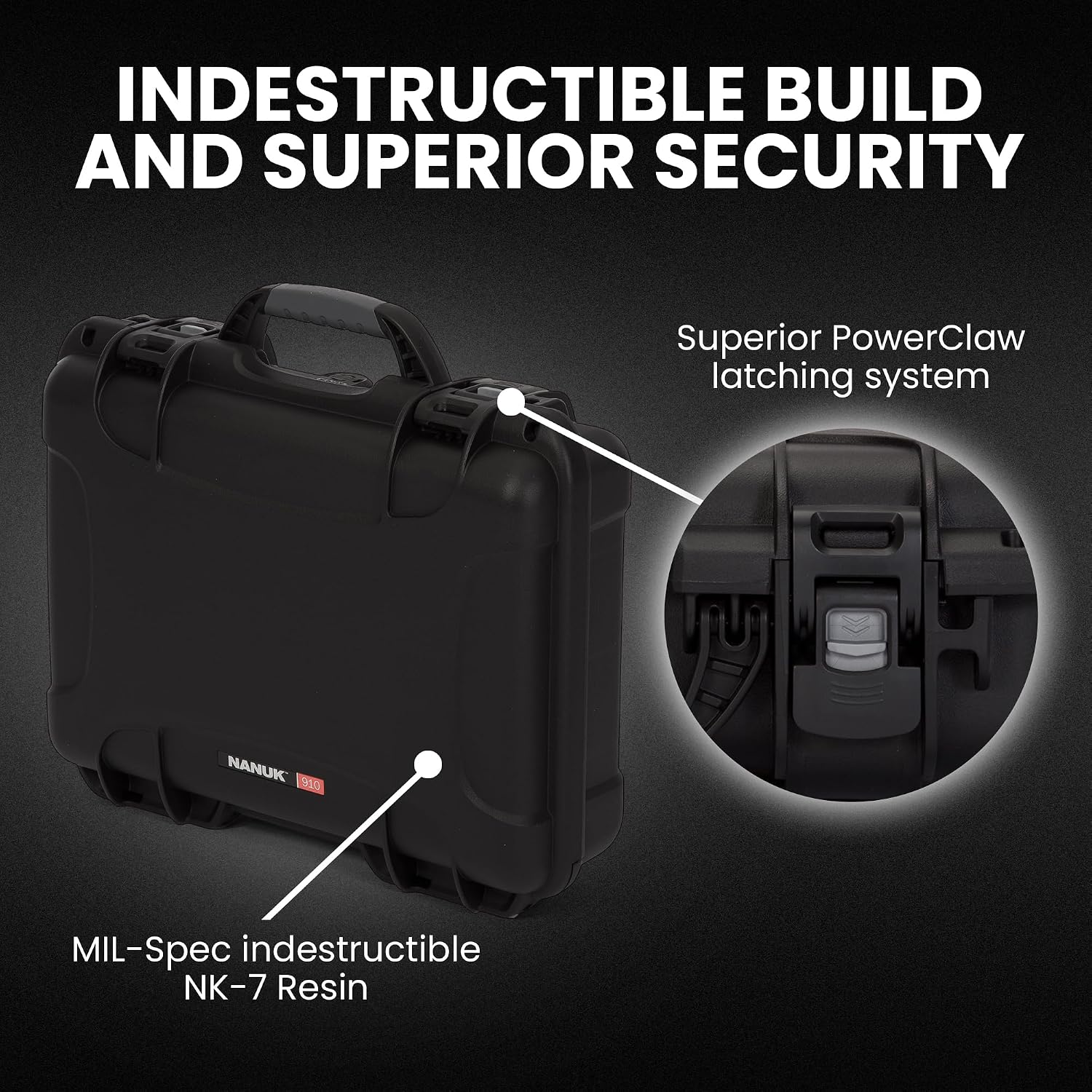
Nanuk 935 — A strong mid-tier alternative for Mavic 3 Pro operators who want a more affordable carry-on option. Interior: 18.8” × 9.8” × 6.9”. Nanuk’s PowerClaw latch system is spec-rated to a higher latch-force threshold than standard Pelican latches, per Nanuk’s published documentation, which operators in wet environments cite as a meaningful seal advantage. The tradeoff: the interior is shallower than a Pelican 1510, so a full battery stack for a six-battery job isn’t happening here.
SKB 3i-2918-10B — The standard hard-case solution for Inspire 2 operators who need a checked-bag aircraft container. Interior: 29.2” × 18” × 10.5”. SKB’s iSeries cases are rated IP67 and carry MIL-STD-810G certification per SKB’s product documentation. Operators at rental houses and broadcast studios favor SKB for stackability — the iSeries line is dimensionally consistent enough to rack in a production van without custom mounting. The SKB warranty (lifetime, per the manufacturer) is a meaningful factor for fleet purchases.
Apache 4800 — The entry-tier case most drone hobbyists encounter first. Interior: 18” × 13” × 6.5”. Manufacturer-rated IPX5 (splash-resistant, not submersible) — not IP67. At a price point well under $100, it’s a rational first-case for a Mini 4 Pro or Air 3 being driven to local shoots. It is not the right call for checked airline baggage on a paid job or for environments with standing water. Outdoor Photographer’s case guide flags the latch durability on Apache cases as the most common long-run complaint from readers.
The “If X, Then Y” Decision Rule
You’ve read the tradeoffs. Here’s the decision frame, compressed:
If your kit is a Mavic 3 Pro or Air 3 and you’re flying commercial on jobs — Pelican 1510 Carry-On, pre-cut foam insert, carry-on workflow for batteries. Full stop. The airline dimension compliance and IP67 + MIL-SPEC dual rating make this the lowest-risk configuration.
If your kit is a Mini 4 Pro and you’re shooting recreation or light commercial work — Nanuk 920 or Pelican 1450 at the mid tier; Apache 4800 if budget is the primary constraint and you’re driving, not flying.
If you’re running an Inspire 2 or Inspire 3 on broadcast or film jobs — You need at minimum a Pelican 1650 or SKB 3i-2918 for the aircraft (checked), plus a dedicated carry-on for batteries. Budget both cases into your kit cost. The aircraft case alone is a $500–$700 purchase; treat it as line-item production equipment, not an accessory.
If you’re a rental house or production company buying fleet — SKB iSeries for stackability and the lifetime warranty math. Per-unit cost is secondary when you need dimensional consistency across twelve units in a production vehicle.
One number to keep front of mind as you finalize the decision: the TSA has no size requirement for checked hard cases, only weight limits (typically 50 lbs on domestic U.S. flights). Your aircraft case can be as large as you need it to be. The carry-on ceiling is the constraint that shapes everything else — and it’s a constraint worth designing your entire kit workflow around before you’re standing at a gate with an oversized case and a flight to catch.