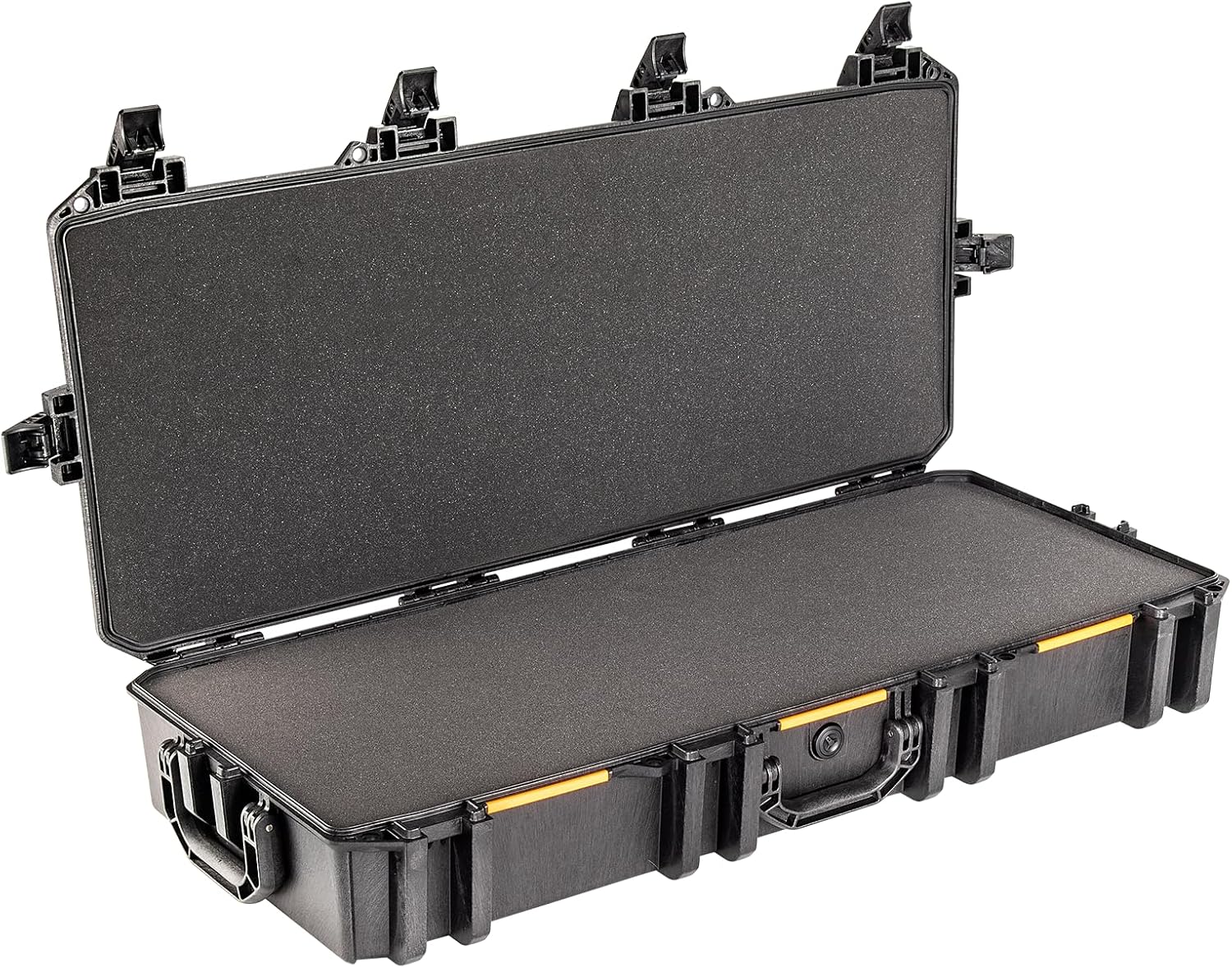
If you’ve ever shipped a cinema tripod, a scoped rifle, or a set of cinema prime lenses across a continent — whether you’re a touring broadcast cinematographer, a government contractor moving sensitive optics, or a serious shooter headed to a remote location — you already know the standard carry-on case doesn’t cut it. Long hard cases (that’s any rigid, lockable protective case typically running 30 to 55 inches in internal length) are the category built for exactly this problem. IP67 is the dust and water protection rating that tells you a case is completely sealed against dust ingress and can survive submersion in up to one meter of water for 30 minutes — the rating that separates “weather-resistant” marketing copy from a real specification you can stake gear on. TSA compliance, in this context, means the case accepts TSA-approved locks or meets Transportation Security Administration checked-baggage requirements for firearms transport, depending on what you’re carrying. This guide walks you through what separates a smart buy from an expensive mistake, with dimension charts, certification breakdowns, and clear decision rules for the 30-to-55-inch category — so you can commit to a case before your next booking.
Why Long Cases Are a Different Problem Than Standard Pelican Cube Cases
Most of the protective case conversation centers on cube-form cases — your Pelican 1510 carry-on, your Nanuk 935, your SKB iSeries 3i-2011. Those are well-documented, well-reviewed, and relatively forgiving in terms of airline compliance because they sit comfortably under standard linear-inch (length + width + height) checked baggage limits.
Long cases break that calculus entirely. A Pelican 1750 — one of the most widely referenced long cases in the category, per Outdoor Life’s editorial review of best rifle cases — measures 53.12 × 13.43 × 6.12 inches externally. That’s a piece of luggage that will not disappear into the baggage carousel anonymously. Baggage handlers will stack it wrong. It will sit in rain on a tarmac. It will get bumped by forklifts in a cargo hold. The gear inside — whether it’s a $12,000 cinema tripod head and legs, a $40,000 Cooke anamorphic set, or a precision rifle with glass that took months to dial in — has exactly one layer of protection between it and a catastrophic failure: the case you chose.
The B&H Photo Video Explora guide on traveling with camera gear notes that long, rigid cases rated for checked airline baggage should meet three criteria before you commit: verifiable IP or equivalent dust/water sealing, a pressure-equalization valve (a small valve that prevents the case from warping under altitude changes in cargo holds), and compatibility with TSA-approved padlock hasps. All three matter. A case missing any one of them is the wrong tool.
By the numbers — key specs at a glance:
| Case | Internal Length | IP Rating | Pressure Valve | Approx. Street Price (2026) |
|---|---|---|---|---|
| Pelican 1750 | 50.5 in | IP67 | Yes | ~$340–$380 |
| SKB 3i-5014 (iSeries) | 50.5 in | IP67 (MIL-SPEC tested) | Yes | ~$420–$470 |
| Nanuk 995 | 47.0 in | IP67 | Yes | ~$360–$410 |
| Pelican 1720 | 42.0 in | IP67 | Yes | ~$290–$330 |
| Nanuk 985 | 39.0 in | IP67 | Yes | ~$290–$340 |
Prices sourced from aggregated retail listings as of mid-2026; street prices fluctuate with demand and distributor inventory.
The Airline and TSA Dimension Reality Check
Here’s where a lot of intermediate buyers get caught: they focus entirely on the gear fit and foam configuration, and then discover at the check-in counter that their case triggers an oversized baggage surcharge — or worse, gets flagged for special handling that the airline can’t accommodate on their aircraft type.
TSA guidance on transporting firearms in checked baggage (published on TSA.gov) requires the case to be hard-sided, completely enclosing the firearm, and locked with a lock only the passenger can open. It does not specify a maximum case dimension, but airlines set their own size and weight limits for oversized checked items. On domestic U.S. routes, most major carriers cap oversized checked bags at 62 linear inches (length + width + height) before oversize fees apply — and long hard cases almost universally exceed this. Budget for the surcharge; it’s not avoidable in this category.
For cinema and broadcast professionals, the firearms-specific language doesn’t apply, but the oversized handling reality does. A Pelican 1750, fully loaded with tripod legs and a fluid head, will routinely come in at 60–80 pounds. Most airline weight limits for standard checked bags are 50 pounds; overweight fees on top of oversized fees are a real line item in your production budget. Factor this in before comparing a $340 Pelican 1750 to a $470 SKB 3i-5014 — the SKB is heavier empty (approximately 22 lbs vs. the Pelican’s 18 lbs), which matters when you’re already pushing weight limits.
Outdoor Photographer’s feature on gear protection for travel consistently flags the weight difference between similarly-spec’d cases as an underappreciated cost over a full year of travel. That’s the right frame: it’s not the one-time purchase price, it’s the total cost over the life of the case.
IP67 vs. MIL-SPEC vs. “Weather-Resistant”: What the Labels Actually Mean
This is worth a clean breakdown because manufacturers use these terms inconsistently, and the distinction matters when gear failure is not an option.
IP67 is an IEC (International Electrotechnical Commission) standard. The “6” means complete protection against dust ingress. The “7” means the case can survive submersion in up to 1 meter of water for 30 minutes. This is a defined, testable standard — not a marketing claim. Pelican, SKB’s iSeries, and Nanuk all publish IP67 ratings for their flagship long cases, and their product documentation backs this up.
MIL-SPEC (short for Military Specification) most commonly refers to MIL-STD-810, a U.S. Department of Defense test standard that covers a range of environmental stresses including temperature extremes, vibration, humidity, and shock. SKB specifically promotes its iSeries cases as meeting MIL-STD-810G/H test protocols for certain environmental categories, per SKB’s published case documentation. MIL-SPEC testing is not the same as IP67 — they measure different things — but a case with both MIL-STD-810 testing and an IP67 rating represents the highest documented protection available in the consumer/professional market.
“Weather-resistant” is a marketing descriptor with no defined standard behind it. A case that claims weather resistance without an IP rating is telling you the shell is made of plastic and has a rubber gasket somewhere. That’s not a specification; it’s a feature description. For anything above $5,000 in gear value, weather-resistant-only cases should not be in your comparison set.
The Outdoor Life review of the best rifle cases explicitly calls out the distinction between IP-rated cases and “splash-resistant” alternatives, noting that shooters who transport optics through wet field conditions consistently report seal integrity failures in non-IP-rated alternatives over multi-year use cycles.
Decision Frame: Which Case for Which Use Case
Here’s where the “if X, then Y” logic earns its keep. The long case category sounds monolithic — they’re all big, they all have foam, they all lock — but the tradeoffs between options are real, and getting this wrong is expensive.
If you are a broadcast cinematographer or AV engineer transporting a full tripod system (legs + fluid head) at 35–50 inches: The Pelican 1750 is the default answer for good reason. The internal dimensions (50.5 × 13.43 × 6.0 inches) handle most 75mm and 100mm fluid heads with legs collapsed, and the case’s reputation in the touring AV community — documented across years of aggregated operator reviews — for surviving ramp handling with zero seal failures is the strongest argument for it. The SKB 3i-5014 is worth the price premium if you’re doing multi-leg international tours where MIL-STD-810 documentation gives you additional leverage in customs or equipment manifest contexts. The SKB’s “trigger release” latch system is consistently noted by long-run reviewers as more positive under repeated use than the Pelican’s standard tongue-and-groove latches.
If you are a production company or rental house building a fleet of long cases: Pelican’s long-case lineup offers the most consistent stackability, with flat-top and flat-bottom geometry that allows clean stacking in cargo vans and production vehicles. SKB’s equivalent cases stack well but have a slightly convex lid profile that reviewers note can create instability in multi-unit stacks without strapping. Nanuk’s 995 and 985 are competitive on price and IP rating but have a smaller dealer/repair network, which matters for rental operations where field warranty service is a real consideration.
If you are a serious rifle shooter transporting a scoped long gun on domestic or international flights: The Pelican 1720 at 42 inches internal length handles most bolt-action and AR-platform rifles with a mounted scope under 20x, per Outdoor Life’s dimension analysis in their long case review. The 1750 provides additional margin for longer barreled configurations or a second rifle. Either case accepts TSA-compliant padlocks on all four hasps. Nanuk’s 995 is a legitimate alternative, with owners consistently reporting positive feedback on the PowerClaw latch system’s security and ease of one-hand operation — useful when you’re managing a case and a boarding pass simultaneously.
If you are in the $200–$300 range and cannot stretch to Pelican or SKB: The Savior Equipment range and similar mid-tier alternatives exist in this category, but published IP ratings are inconsistently documented by manufacturers in this price tier. If IP67 is a hard requirement — and for checked airline baggage, it should be — the entry point for a verifiable IP67 long case is effectively the Pelican 1720 at approximately $290 street. There is no verified shortcut below that price point in this length category as of mid-2026.
One Decision You Cannot Outsource: Foam Configuration
The case gets you to the destination. The foam gets your gear there intact. This is worth naming explicitly because long-case foam is not a standard afterthought — it’s an active engineering decision.
All three major brands (Pelican, SKB, Nanuk) ship long cases with either Pick N Pluck foam (a foam block pre-scored in a grid so you can pull out cubes to create custom cavities) or TrekPak dividers (a panel-and-clip system that creates padded channels without cutting foam). For cinema lenses and precision optics, TrekPak-style divider systems — available as aftermarket upgrades for Pelican cases through the Pelican accessories catalog — are consistently preferred by reviewers because they allow reconfiguration between jobs without permanently altering the foam. For rifles with fixed stock configurations, cut foam or molded foam inserts (available from Foam Factory and similar suppliers) offer better retention.
The B&H Explora gear-travel guide notes that misfit foam — meaning foam that allows gear to shift even slightly during transport — is the leading cause of optics damage inside otherwise intact cases. A case that survives the baggage throw but delivers a decentered lens element is still a mission failure.
Get the foam right. Then lock the case. Then hand it to the handler knowing you’ve done everything that could be done.
Sources referenced in this article: Pelican Products, Inc. product specification documentation for the 1750 and 1720 case series; SKB Cases iSeries product documentation and MIL-STD-810 testing disclosures; B&H Photo Video Explora, “How to Travel With Camera Gear on a Plane”; Outdoor Life, “The Best Rifle Cases” editorial review; Nanuk Cases product specification documentation for the 985 and 995 series; TSA.gov, “Transporting Firearms and Ammunition” regulatory guidance; Outdoor Photographer, “Protecting Your Gear: Cases for the Road.”