If you’ve ever handed a $6,000 camera body or a $4,000 drone over to an airline baggage handler and felt your stomach drop, you already understand the case. A hard-shell protective case is exactly what it sounds like: a rigid, sealed box — usually injection-molded plastic — designed to absorb impacts, block water, and prevent dust from reaching the sensitive electronics inside. The standard most serious buyers reference is IP67, which is a globally recognized ingress protection rating (ingress meaning “entry”) that certifies the case is completely dustproof and can survive submersion in up to one meter of water for 30 minutes. Nanuk, a Canadian manufacturer, builds its entire lineup to that IP67 standard. The question this guide answers is which Nanuk — from the compact 904 up to the expedition-scale 960 — actually fits what you’re carrying, how you’re traveling, and what you’re willing to spend. We did the spec-sheet work so you don’t have to make that decision based on guesswork.
| EDITOR'S PICK[NANUK 935 Pro Photo Kit](https://www.amazon.com/dp/B07WT6JLP1?tag=greenflower20-20) – Water… | Mid-tier[NANUK 920 Hard Case](https://www.amazon.com/dp/B003JH7XC4?tag=greenflower20-20) – Waterproo… | Budget pick[NANUK 904 Hard Case with Foam](https://www.amazon.com/dp/B00BP8URVS?tag=greenflower20-20) –… | |
|---|---|---|---|
| Internal Dims | 22" x 14" x 9" | 16.7" x 13.4" x 6.8" | 10.2" x 7.9" x 4.5" |
| Interior Type | Padded Dividers | Cubed Foam | Cubed Foam |
| Carry-on Size | ✓ | ✓ | — |
| Wheels | ✓ | ✗ | ✗ |
| Color | Olive | Black | Black |
| Price | $307.46 | $119.96 | $41.21 |
| See on Amazon → | See on Amazon → | See on Amazon → |
Why the Nanuk Lineup Is Worth Mapping Out Before You Buy
Nanuk doesn’t sell one case in multiple colors. Each model number corresponds to a meaningfully different interior volume, exterior footprint, and — critically — a different relationship to airline carry-on and checked-bag rules. The model numbers run roughly in ascending size order: 904, 910, 915, 920, 923, 925, 930, 933, 935, 940, 945, 950, 960. That’s thirteen distinct sizes as of the 2025 product lineup, according to Nanuk’s official specification sheets.
That range is broader than most buyers realize, and it creates a real decision trap: buy too small and your lens won’t close properly; buy too large and you’re checking a case that could have been a carry-on. The math matters here.
The Architecture Under the Shell
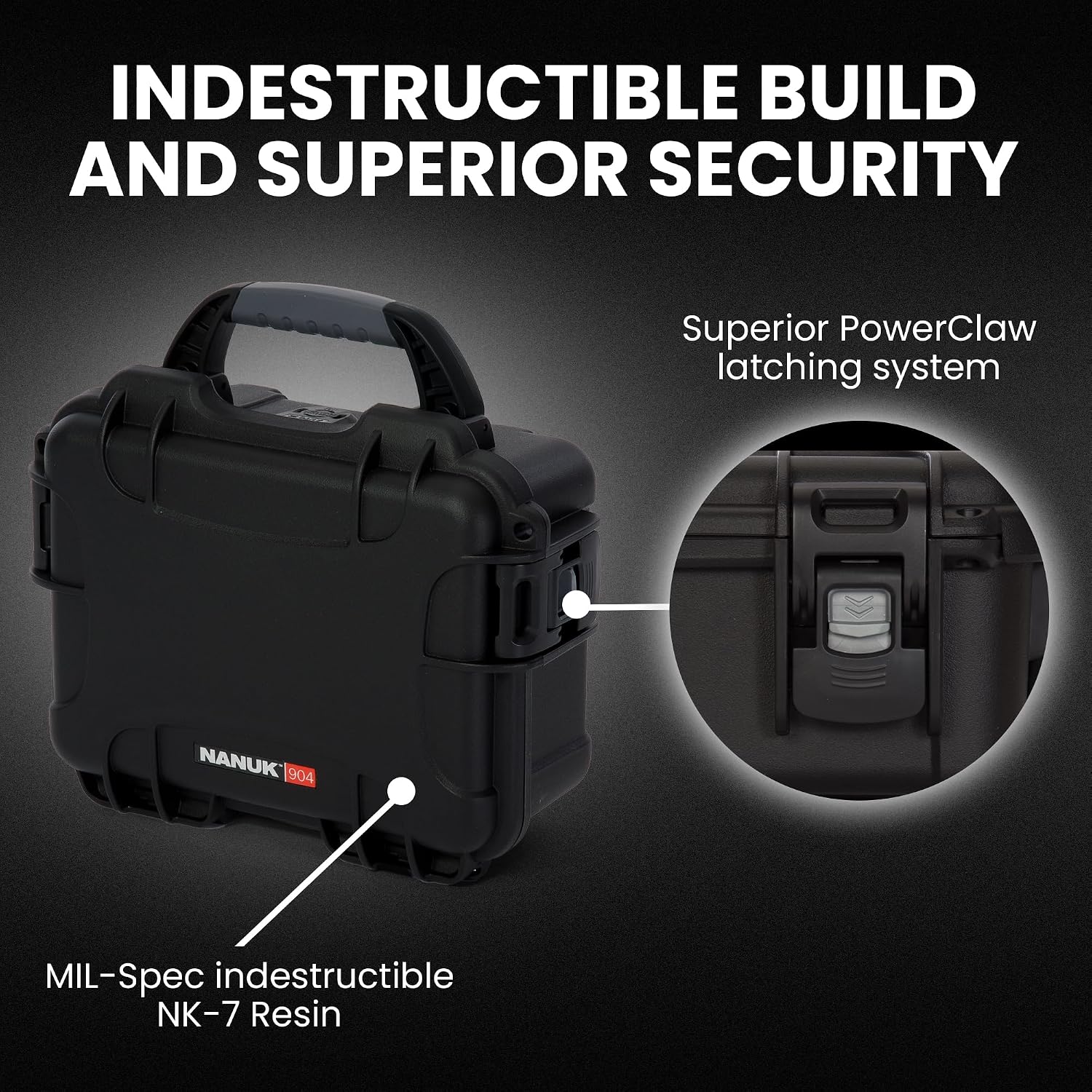
Before the size comparison, it helps to know what every Nanuk shares. All models in the current lineup are built from NK-7 resin, Nanuk’s proprietary glass-filled copolymer polypropylene — a material chosen for its balance of rigidity and impact absorption, as documented in Nanuk’s published material specifications. Every case ships with their PowerClaw latching system, a spring-loaded closure that operators in long-run reviews consistently describe as requiring meaningful force to open accidentally (which is exactly what you want when a case falls off a cart). An automatic purge valve equalizes pressure during altitude changes — relevant if you’re flying these cases as checked luggage or traveling through mountain ranges. And the Nanuk-branded cubed foam insert, which ships standard, is pull-apart — meaning you remove individual foam cubes to create a custom cavity rather than cutting foam with a knife, which reduces material waste and makes reconfiguration faster when your kit changes.
The B&H Photo Explora buying guide notes that pull-apart foam is a meaningful workflow advantage for rental houses and production companies that rotate different gear through the same case fleet.
Size Tiers: Matching the Case to the Kit
Here’s where the decision actually gets made. Think of the lineup in three operational bands:
Band 1: Compact and Carry-On (904 through 920)
Nanuk 904 — Interior: 8.9 × 5.1 × 3.7 in (226 × 130 × 94 mm). This is a one-lens, one-body case, or a home for a single mirrorless body with a short prime attached. Outdoor Photographer’s 2024 field reviews position cases this size as ideal for trail photographers or videographers who want a waterproof “hero compartment” inside a larger bag — not a standalone travel case. If you’re carrying a Sony A7 series body with a 35mm prime, or a single DJI action camera, the 904 closes cleanly. If you’re carrying a Sony FX3 with a cage attached, it doesn’t.
Nanuk 910 — Interior: 10.0 × 7.0 × 5.0 in (254 × 178 × 127 mm). This size crosses into “small drone” territory. DJI Mini 4 Pro with one or two additional batteries fits here with room to spare, per dimensions confirmed against DJI’s published hardware specs. A mirrorless body with a 24–70mm attached also fits. This is the most popular entry-point case for enthusiasts building their first serious protection workflow, based on aggregated review patterns at DPReview.
Nanuk 915 — Interior: 13.0 × 9.4 × 6.2 in (330 × 239 × 157 mm). Volume jumps meaningfully here. This is where a DJI Mavic 3 Pro with controller, multiple batteries, and ND filter set starts to fit comfortably. For camera shooters, it accommodates a mirrorless body with a 70–200mm attached, or two bodies with primes.
Nanuk 920 — Interior: 15.0 × 10.5 × 6.2 in (381 × 267 × 157 mm). This is the workhorse of the compact band. At exterior dimensions of approximately 17.3 × 12.5 × 7.5 in, it falls within most major U.S. carriers’ carry-on overhead bin limits — though you should verify against your specific airline’s current policy before travel, since those limits change. The 920 is the case most frequently cited in The Drone Girl’s drone travel case guide for operators running a Mavic 3 series or Air 3 setup who want overhead-bin eligibility.
Band 2: The Checked-Bag Sweet Spot (923 through 935)
Nanuk 923 — Interior: 15.0 × 10.5 × 9.0 in (381 × 267 × 229 mm). The 923 is dimensionally close to the 920 in its footprint but significantly deeper — that extra 2.8 inches of depth is where a second layer of gear lives. Think: drone body on top, battery bank and accessories below. Or: cinema camera body in the main cavity, cards and cables in a top tray.
Nanuk 925 — Interior: 17.0 × 11.8 × 6.4 in (432 × 300 × 163 mm). This case has a wider footprint than the 920 at a similar depth, making it better suited to wider bodies — like a cinema camera body with a top handle or matte box rails removed but overall width still large. Operators running RED Komodo-X rigs without the cage frequently reference this size in DPReview community threads on case selection.
Nanuk 930 — Interior: 18.0 × 13.0 × 6.6 in (457 × 330 × 168 mm). This is the first case in the lineup that comfortably handles a two-body professional stills kit — two full-frame DSLRs or mirrorless bodies, three to four lenses, and a flash unit. It also appears regularly in broadcast cinematographer workflows for a single cinema camera body with lens attached.
Nanuk 933 — Interior: 19.9 × 13.9 × 7.8 in (506 × 353 × 198 mm). Volume is climbing fast here. The 933 handles a drone like the DJI Inspire 3 (without propellers) alongside its remote and a battery pair. For camera work, this is a three-lens kit case for professionals who don’t want to split across multiple cases.
Nanuk 935 — Interior: 20.5 × 11.3 × 7.5 in (521 × 287 × 191 mm). Note that the 935 is narrower than the 933 despite a larger model number — the interior is optimized for a portrait-oriented configuration, making it a strong choice for long telephoto lenses or a cinema camera body oriented upright with a large zoom attached. Outdoor Photographer has flagged the 935 repeatedly as a standout for wildlife and sports photographers who travel with a 400mm or 600mm prime.
Band 3: Fleet and Expedition Scale (940 through 960)
Nanuk 940 — Interior: 22.0 × 17.0 × 8.4 in (559 × 432 × 213 mm). At this size, you’re building a system case, not a single-kit case. Production companies sourcing multiple units for rental fleets frequently land here for audio or video equipment that spans multiple components: a cinema camera body, multiple lenses, a wireless audio kit, and power distribution hardware can all coexist.
Nanuk 945 — Interior: 22.0 × 17.0 × 12.2 in (559 × 432 × 310 mm). Same footprint as the 940 with a significantly deeper interior. This is where a two-drone setup lives — or a full broadcast camera system with shoulder rig hardware stored separated by foam layers.
Nanuk 950 — Interior: 25.2 × 18.0 × 12.4 in (640 × 457 × 315 mm). The 950 is positioned in Nanuk’s lineup as a heavy-duty checked or ground-transport case. At this scale, military and government contractors sourcing protective cases for sensor equipment or comms hardware are the primary buyer profile.
Nanuk 960 — Interior: 30.7 × 17.0 × 12.4 in (780 × 432 × 315 mm). This is the top of the standard lineup. The 960 is explicitly designed for cases where interior length is the critical constraint — long rifles, full tripod systems with head attached, or a complete drone like the DJI Matrice series with folded arms. Per Nanuk’s published specifications, the exterior of the 960 puts it firmly in freight or ground-transport territory for air travel.
By the Numbers: Key Interior Volumes at a Glance
| Model | Interior (in) | Approx. Volume (L) | Best-Fit Use |
|---|---|---|---|
| 904 | 8.9 × 5.1 × 3.7 | ~0.87 | Single mirrorless body + prime |
| 920 | 15.0 × 10.5 × 6.2 | ~5.9 | DJI Mavic 3 + accessories; carry-on candidate |
| 935 | 20.5 × 11.3 × 7.5 | ~10.2 | Telephoto kit; cinema body upright |
| 950 | 25.2 × 18.0 × 12.4 | ~26.2 | Full broadcast system; two-drone setup |
Volume figures are editorial estimates derived from published interior dimensions. Always verify against Nanuk’s current specification sheets before purchasing.
The Decision Rules
Here’s what you should consider if you are a drone operator flying commercially with a Mavic 3 series or Air 3:
The Nanuk 920 is where most operators land for carry-on eligibility. If you’re adding a second battery set and a ND filter wallet, confirm your airline’s current carry-on size limit before departure — the 920 is at the edge of compliance on many carriers. The 915 gives you a margin of safety but sacrifices accessory room.
Here’s what you should consider if you are a broadcast or cinema camera operator traveling with a checked bag allowance:
The 930 or 933 handles most single-camera systems without fragmentation across multiple cases. If your rig has a cage, top handle, or matte box rails that you’re leaving attached, measure the assembled rig before selecting a model — Nanuk’s spec sheets publish interior dimensions, not assembled-rig clearance.
Here’s what you should consider if you are a production company or rental house sourcing multiple units:
The 935 and 940 are the most consistently stackable units in the lineup based on operator reports in aggregated reviews. Uniform sizing across a fleet reduces warehouse complexity and makes damage tracking easier. Nanuk’s warranty — a lifetime guarantee per the manufacturer’s published policy — removes the per-unit insurance calculation that often complicates fleet procurement.
Here’s what you should consider if you are a first-time buyer protecting a mirrorless enthusiast kit:
The 910 is a rational starting point at a price point that won’t require justification. It grows with a one-battery drone or a two-prime lens kit. If you know your kit will expand within 12 months, buy the 920 now — the cost difference is modest and the interior flexibility is significant.
The Nanuk lineup rewards deliberate selection. Measure what you’re protecting, check the published interior specs against those measurements with at least an inch of foam buffer on each axis, and then cross-reference the exterior dimensions against your specific airline’s current carry-on or checked-bag policy. That workflow, done once before purchase, is the whole job.