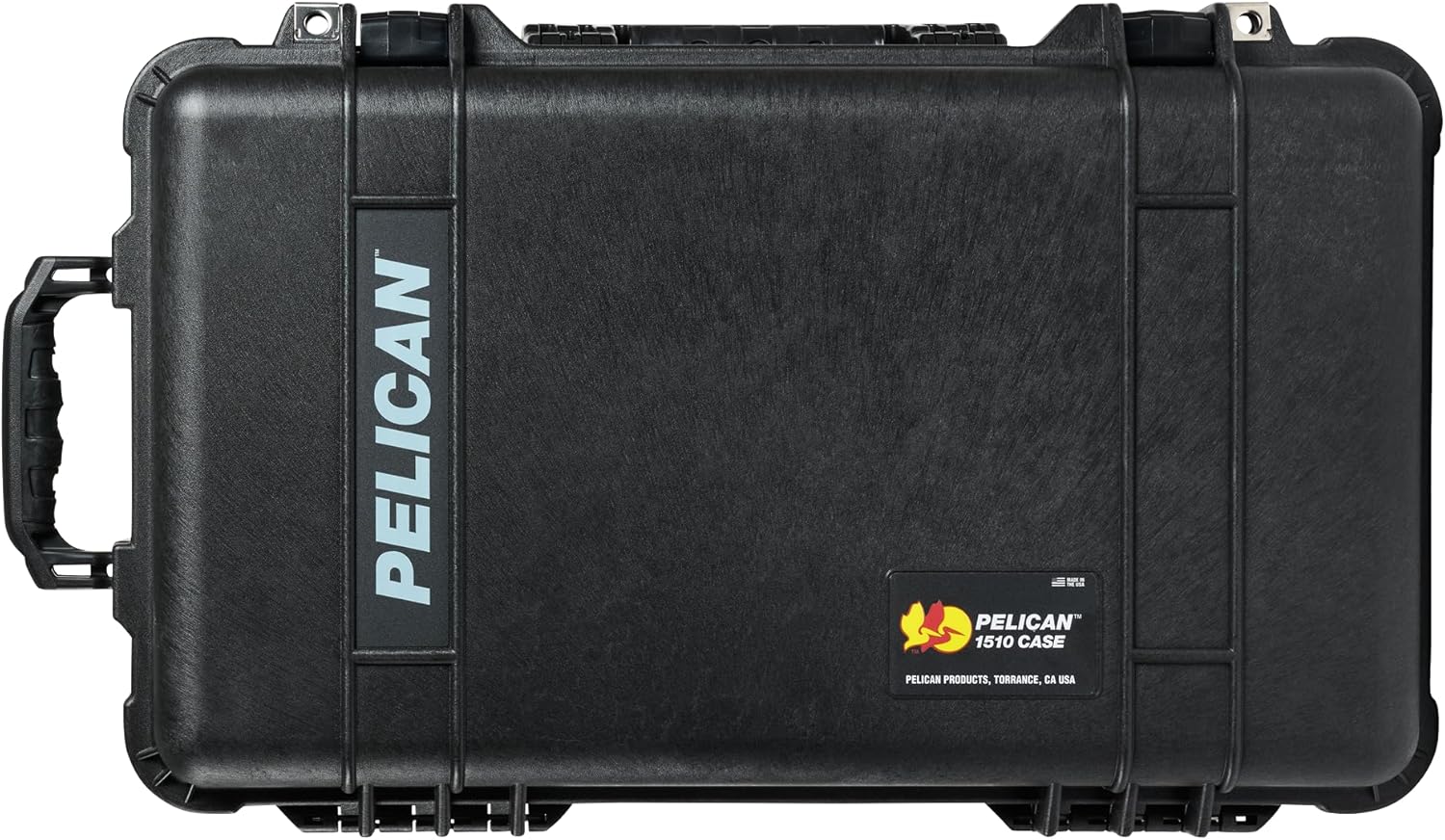
If you fly with expensive gear — cameras, audio recorders, lenses, drones — you already know that checking it as luggage feels like handing your livelihood to a roulette wheel. A hard case (a rigid, lockable shell designed to protect fragile equipment from impact, crushing, and water) is the standard answer. The Pelican 1510 is the case that shows up on almost every short list, and for good reason: it’s built to an IP67 water-resistance rating (meaning it can survive being submerged in up to one meter of water for 30 minutes), it uses a TSA-recognized lock system (so airport security can open it without cutting it), and it fits — usually — in an overhead bin. That word “usually” is doing a lot of work, and it’s exactly what this guide unpacks. By the end, you’ll know which major carriers reliably accept the 1510, what their size rules actually say, and why the number you should be obsessing over is not the outside of the case but the inside.
The Dimension Problem: Outside vs. Inside Is Not a Rounding Error
Let’s start with the numbers that matter, because this is where a lot of practitioners get caught off guard.
By the numbers — Pelican 1510 published specifications (per Pelican Products, Inc.):
| Measurement | Exterior | Interior |
|---|---|---|
| Length | 22.0 in (55.9 cm) | 19.75 in (50.2 cm) |
| Width | 13.8 in (35.1 cm) | 11.0 in (27.9 cm) |
| Depth | 9.0 in (22.9 cm) | 7.5 in (19.1 cm) |
That 2.25-inch difference in length and 1.5-inch difference in depth between exterior and interior is not trivial. If you’re planning to pack a Sony FX3 body, a couple of primes, and a small audio kit, the usable interior volume — 1,629 cubic inches, per the spec sheet — is your real working constraint, not the glamour number on the outside of the box. Practitioners who figure this out the hard way are the ones who show up on set with a perfectly airline-compliant case and realize their wireless follow focus system doesn’t fit the foam insert they ordered.
The foam situation matters here too. The 1510 ships with Pick N Pluck foam — a grid-scored foam block where you remove individual cubes to create custom cavities. That’s flexible, but the scoring grid means your cavities will always be multiples of roughly half an inch. If you’re packing irregular shapes — a DJI Mavic 3 Pro with props attached, for example — community members on DPReview’s gear travel threads consistently report cutting custom foam inserts rather than relying on the factory Pick N Pluck alone. Keep that workflow cost in mind when you’re pricing out your total carry-on solution.
Which Airlines Actually Accept the Pelican 1510?
This is where the straightforward answer gets complicated. Airlines publish carry-on size limits, but those limits are applied inconsistently, enforcement varies by gate agent, and “fits in the sizer” is not the same as “meets the published policy.” Here’s a carrier-by-carrier breakdown based on published policy documentation and aggregated real-world operator reports.
The Major U.S. Carriers
American Airlines publishes a carry-on maximum of 22 × 14 × 9 inches. The Pelican 1510’s exterior dimensions — 22.0 × 13.8 × 9.0 inches — land exactly at or just inside every axis of that limit. American’s customer service documentation specifies that items must fit in the overhead bin, not merely meet the size rule in isolation. In practice, operators traveling on American with the 1510 report consistent acceptance in overhead bins on mainline narrowbody aircraft (737 series, A321). Regional jets — the smaller aircraft that serve secondary routes — are the caveat. American Eagle-operated CRJ-700s and ERJ-145s have significantly smaller overhead bins, and operators report the 1510 getting gate-checked on these routes even when they’ve boarded successfully on a mainline leg.
Delta Air Lines lists its carry-on size limit as 22 × 14 × 9 inches, identical to American’s published policy. Delta’s Help Center documentation notes that the bag must fit comfortably overhead or under the seat in front. “Comfortably” is doing enforcement work there — Delta gate agents have historically been reported as slightly more lenient on the 1510 than regional carriers. On mainline Delta routes, B&H Photo Video Explora’s carry-on gear coverage notes the 1510 as a broadly accepted professional carry-on, with the regional jet caveat applying equally here.
United Airlines publishes a 22 × 14 × 9 inch limit. The story is the same: mainline yes, regional caution.
Southwest Airlines is a notable outlier. Southwest’s published carry-on dimensions are 24 × 16 × 10 inches — meaningfully larger than the legacy carriers — and the 1510 fits comfortably within that envelope. Southwest also does not charge carry-on fees, and their boarding process (open seating) means overhead bin access is first-come-first-served. Operators who route through Southwest-heavy hubs for domestic legs frequently choose Southwest specifically because the 1510 never causes friction.
International Carriers: The Rules Tighten
If you’re hauling gear internationally, the situation shifts. Many European carriers — including Lufthansa, Ryanair, and British Airways — publish carry-on maximums that are smaller than U.S. standards, often in the range of 55 × 40 × 23 centimeters (roughly 21.7 × 15.7 × 9.1 inches). The Pelican 1510 at 55.9 cm in length technically exceeds Lufthansa’s 55 cm limit by under a centimeter. Ryanair’s limits are stricter still and applied with notably more consistency than U.S. legacy carriers.
Outdoor Photographer’s working-pro travel guide advises always checking the specific carrier’s current policy before booking on international routes, noting that the 1510 “is essentially sized for the U.S. domestic carry-on envelope and should be treated as a check-in case on strict-enforcement European carriers.” That’s the honest tradeoff: the 1510 is optimized for domestic U.S. travel. If half your work is transatlantic or trans-Pacific on flag carriers with rigid enforcement, you should be evaluating that tradeoff explicitly before building your kit around this case.
The Musical Instrument Exception and Why It Doesn’t Apply Here
Some practitioners assume hard instrument cases get treated differently under FAA rules. The FAA Modernization and Reform Act of 2012 does give passengers the right to bring small musical instruments as carry-on items if they fit in the overhead bin. The Pelican 1510 is not a musical instrument case, and this carve-out doesn’t extend to camera or AV equipment. Knowing this matters because gate agents occasionally push back on hard cases categorically — and you should know that the instrument exception won’t help you make your case (so to speak).
What “TSA-Accepted” Actually Means for You
TSA-accepted, in the context of hard cases, refers to cases that use TSA-recognized locking systems — specifically, locks keyed to the Transportation Security Administration’s master key system, sometimes branded as Travel Sentry or Safe Skies. These locks allow TSA agents to open and re-secure your case without forcing it, which protects both the lock and the case body.
The Pelican 1510 uses a traditional hasp closure, not an integrated TSA lock. You add TSA-recognized locks separately, through the hasp loops on the exterior. This is actually the preferred configuration for working professionals: you control the lock quality, you can replace a broken lock without sending the case in for service, and you can use a single TSA-recognized padlock on each of the two hasp points.
The practical implication: if TSA does need to inspect your case in the hold (if it gets gate-checked on a regional leg, for example), they can open it with their master key. If you’ve used a non-TSA lock, they will cut it. Own at least two TSA-recognized padlocks per case and attach them before you leave for the airport.
Interior Dimension Decisions: Gear Compatibility Mapping
Here’s where the decision gets concrete. Before you commit to the 1510, map your actual gear to the interior dimensions — 19.75 × 11.0 × 7.5 inches — not the exterior.
If you’re carrying a Sony FX3 body with kit lens attached: The FX3 body is approximately 5.0 × 3.5 × 3.4 inches. With a compact zoom attached, you’re looking at a footprint near 7.5 × 4.0 × 5.0 inches. That fits in the 1510’s interior with room for two additional lenses and a small audio kit — but only if your foam insert layout is planned, not improvised. Operators on DPReview’s gear travel threads consistently flag that the factory Pick N Pluck layout requires careful planning to avoid wasted space around irregular camera body shapes.
If you’re carrying a DJI Mavic 3 Pro with controller and batteries: The drone body folds to approximately 9.6 × 5.3 × 3.5 inches. You can fit the drone, RC controller, and four to five Intelligent Flight Batteries in the 1510’s interior — tight, but documented by multiple operators in community forums. Custom-cut foam inserts are strongly recommended over Pick N Pluck for drone kits, because the battery geometry doesn’t align with the grid scoring.
If you’re carrying a compact audio kit — wireless transmitter/receiver pairs, small mixer: The 1510 is a natural fit here. The interior depth of 7.5 inches accommodates most compact receiver units upright, and the 11-inch width lets you run two rows of channels side by side.
Here’s what you should consider if you are trying to decide whether the 1510 interior is enough:
- If your primary body is a mirrorless camera at or below Sony FX3 / Nikon Z6 III in size, with up to four compact-to-midsize lenses, the 1510 handles it.
- If you’re carrying a larger cinema body — a RED Komodo or BMPCC 6K with rails — you will hit the interior depth limit quickly and should be looking at the Pelican 1514 (which shares the same exterior footprint but adds a divider-based interior) or stepping up to the Pelican Air 1615 for overhead or the 1650 for checked.
- If you’re regularly on regional jets, plan for gate-check on those routes and use TSA-recognized locks every time you fly.
The Decision Rule
The 1510 earns its reputation on U.S. domestic mainline routes, particularly on legacy carriers flying narrowbody mainline aircraft. It is the right tool if your routes are predominantly domestic, your gear fits the interior dimensions with a planned foam layout, and you’re willing to attach TSA locks every single trip. It is the wrong tool if you’re primarily flying international flag carriers with strict enforcement, or if you’re routinely on regional jets where gate-check is nearly inevitable. In those cases, the exterior dimensions that make the 1510 carry-on legal on a 737 become liabilities on a CRJ.
If the 1510 fits your route profile and your gear profile, it’s a rational purchase. If either of those conditions doesn’t hold, name that tradeoff now — before you’ve built a foam insert workflow around a case that spends half its flights in the hold anyway.