If you’ve ever stood at an airline check-in counter with a case full of camera gear and felt your stomach tighten when the agent reached for the scale, you already understand what this decision is really about. Hard cases — the rigid, lockable, foam-lined shells designed to protect expensive electronics during air travel and transport — are the last line of defense between your gear and a five-figure insurance claim. Two names come up constantly at this price and size tier: the Pelican Air 1615 and the Pelican 1650. Both are large-format cases built to swallow a full cinema camera rig, a set of lenses, batteries, and accessories in a single container. Both are made by Pelican Products, one of the most respected case manufacturers in the industry. But they make different promises — and choosing the wrong one before a long-haul job can cost you in ways that aren’t obvious until you’re at the gate. This guide breaks down exactly where those differences live, so you can make the call with confidence.
The Core Tradeoff: Weight Budget vs. Interior Volume
This is the decision frame everything else flows from, so let’s name it directly.
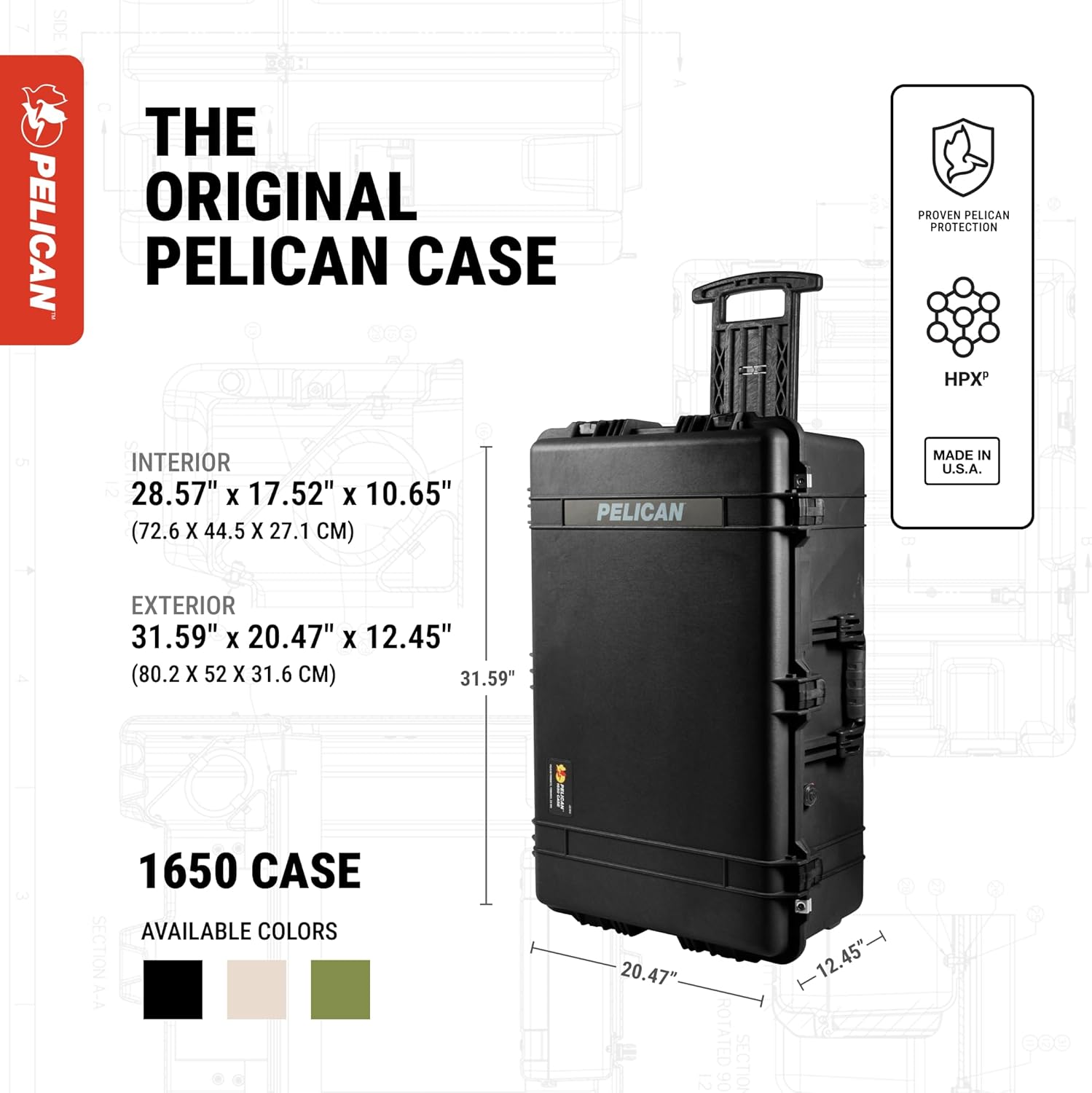
The Pelican 1650 is the classic workhorse. It’s built from Pelican’s standard HPX (High Performance eXtreme) resin — a thick-walled, dense polymer that has earned a reputation over decades for surviving freight handlers, desert heat, and military transport. Per Pelican Products’ published specification sheet for the 1650, the case’s empty weight is approximately 16.40 lbs (7.44 kg). That is a heavy case before you put a single piece of gear inside.
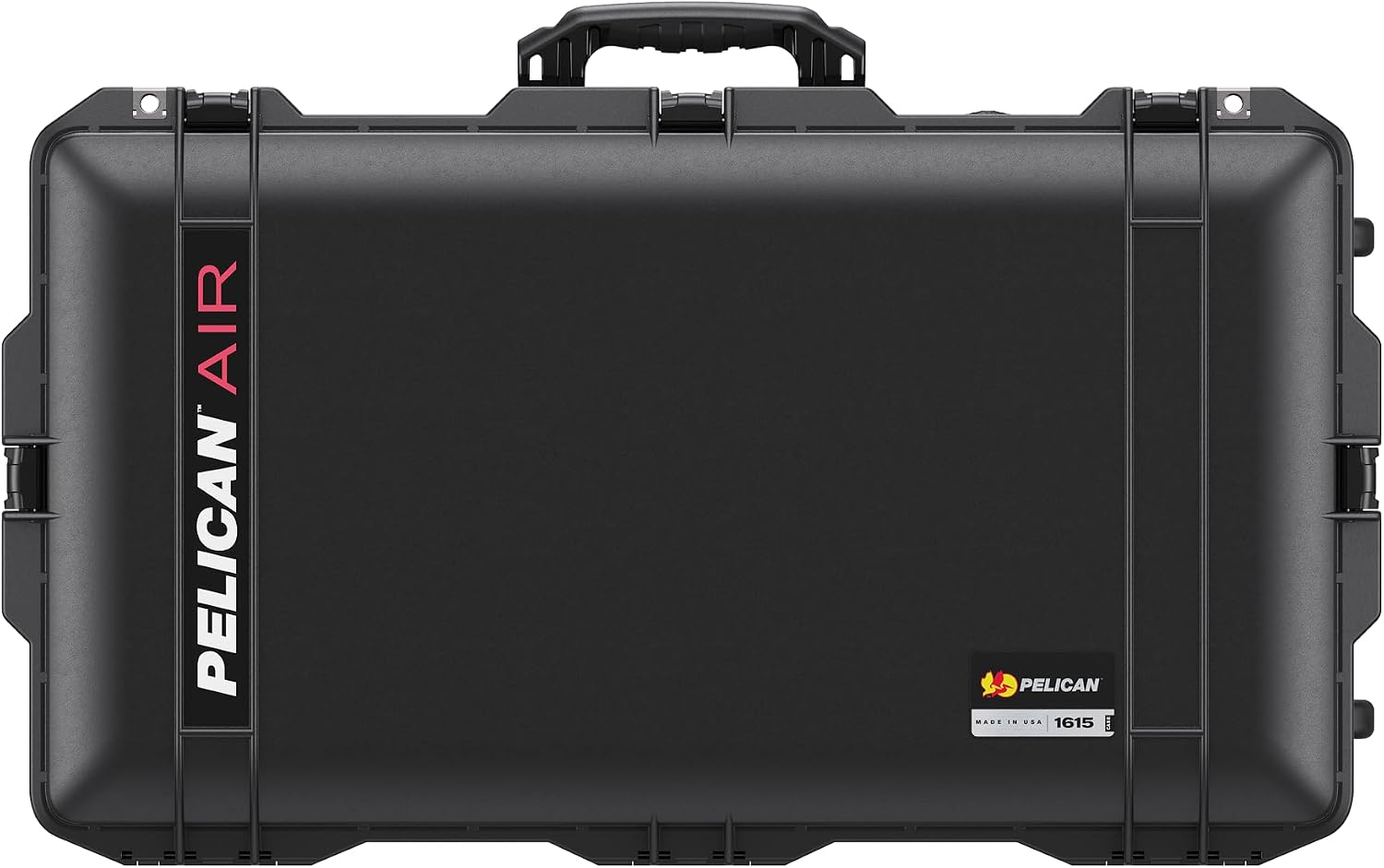
The Pelican Air 1615 is Pelican’s answer to the weight problem. Introduced as part of the Air series, it uses a different polymer formulation and structural design philosophy to shed mass while targeting the same IP67 protection rating — meaning the case is dust-tight and rated to withstand submersion in up to one meter of water for thirty minutes, per the IEC standard for ingress protection. Per Pelican Products’ published specification sheet for the Air 1615, the case’s empty weight is approximately 9.97 lbs (4.52 kg).
That’s a 6.4 lb difference on an empty case. At most major airlines in 2026, standard checked-bag weight limits sit at 50 lbs, with overweight fees typically running $100–$200 per bag per leg. Six and a half pounds of empty-case weight is gear you cannot bring, or money you will spend on every trip.
Comparing the Two Cases Side by Side
Interior Dimensions and Depth
Pelican
$404.95
In stock on Amazon
Check price on AmazonThe 1650’s interior — approximately 24.38 × 20.06 × 10.31 inches per Pelican’s published specs — gives you enough depth to accommodate a Sony FX3 body with a cage and side handle laid flat without compressing the foam lid, or a DJI Mavic 3 Pro folded body standing vertically with clearance to spare. For a RED Komodo rig with rails, a follow-focus motor, and a clip-on matte box, the 1650’s extra interior depth is frequently cited in DPReview operator discussions on checked-bag strategy as the deciding factor for partially assembled rigs.
The 1615 Air’s interior — approximately 22.00 × 17.00 × 8.00 inches per Pelican’s published specs — is workable for most cinema camera bodies, including the BMPCC 6K and Canon C70, but becomes a constraint once you add cage hardware that extends upward. B&H Explora’s guide “Hard Cases Explained: What to Look For Before You Fly” notes that rail-based accessories and monitor arms commonly add 1.5 to 2.5 inches to a camera’s effective assembled height, which can push a fully rigged body right to the 1615’s lid limit.
Pelican
$429.95
In stock on Amazon
Check price on AmazonEmpty Weight and Airline Math
Pelican
$404.95
In stock on Amazon
Check price on AmazonHere is the arithmetic that matters on a long-haul job. A realistic Sony FX3 travel kit — body, two cinema prime lenses, V-mount batteries, a SmallHD monitor, and essential accessories — weighs roughly 14–18 lbs based on published product weights from those respective manufacturers. Add the 1650 at 16.4 lbs empty and you’re at 30–35 lbs before cables, chargers, or a second battery system. That’s still under the 50 lb limit on most carriers, but with thin margin.
Add a second lens, a portable hard drive kit, or a microphone system — all common additions on a broadcast or commercial job — and you’re at or near 50 lbs, looking at overweight fees on every leg. On a round-trip with a connection, that’s potentially $400–$800 in fees on a single trip.
The 1615 Air at 9.97 lbs gives back roughly 6.4 lbs of usable gear weight on every flight. Sound On Sound’s feature “Fly-Away Kit: Protecting Audio and Video Gear in Transit” notes that for touring broadcast engineers who check cases on dozens of flights per year, the weight savings of Air-series cases represent a calculable operating cost reduction rather than a luxury upgrade.
Pelican
$429.95
In stock on Amazon
Check price on AmazonFoam Compatibility and Fleet Logistics
Pelican
$49.95
In stock on Amazon
Check price on AmazonBoth cases ship with standard convoluted (egg-crate) foam in the lid and a bottom layer of Pick N Pluck foam — the pre-scored grid foam you pull apart in cubes to create custom cavities. The Pick N Pluck cell size is consistent between models, but the interior dimensions differ enough that any custom foam insert cut for the Pelican 1650 will not transfer to the 1615 Air without re-cutting. If you’re buying into a rental fleet where someone has already paid for custom foam work, verify which chassis the foam was cut for before ordering.
Third-party foam providers such as Foam Factory and Custom Case Foam — both frequently referenced in DPReview’s operator communities — offer pre-cut insert kits for both models, but each SKU is specific to that case’s interior dimensions. Confirming the correct model before ordering is worth the extra step if you’re relying on a drop-in solution timed to a job start.
For production companies managing a fleet of cases across multiple units, the foam-compatibility issue compounds. Per-unit cost savings from switching models mid-fleet can be offset quickly by the labor cost of re-cutting or re-ordering foam profiles for a dozen cases. Outdoor Photographer’s piece “Traveling Light (and Safe) with Your Camera Gear” makes a broader point that applies directly here: the best protective system is a consistent one, because inconsistency creates the gaps where damage happens.
Pelican
$49.95
In stock on Amazon
Check price on AmazonA Shared Specification List Worth Noting
Both the 1615 Air and the 1650 carry the same IP67 rating, the same automatic pressure-equalization valve (which prevents the lid from vacuum-sealing at altitude — a detail that matters on pressurized aircraft holds), and Pelican’s lifetime guarantee. Both are compatible with TSA-accepted lock hardware. Neither case will fail you on protection fundamentals. The decision is purely about volume, weight budget, and how the math shakes out for your specific shooting schedule.
| Specification | Pelican Air 1615 | Pelican 1650 |
|---|---|---|
| Empty weight | ~9.97 lbs (4.52 kg) | ~16.40 lbs (7.44 kg) |
| Interior L×W×D | 22.00 × 17.00 × 8.00 in | 24.38 × 20.06 × 10.31 in |
| IP rating | IP67 | IP67 |
| Pressure relief valve | Yes | Yes |
| Lifetime guarantee | Yes | Yes |
Specifications per Pelican Products’ published product sheets for the Air 1615 and the 1650.
Where the 1650 Remains the Rational Pick
Nothing above means the 1650 is the wrong choice. Here are the scenarios where it stays the right answer.
You’re working with a rail-based or partially assembled rig. If your camera package includes a full cage, baseplate, 15mm rods, and a follow-focus system that you leave assembled for speed-of-setup reasons on location, the 1650’s extra interior depth accommodates that configuration in ways the 1615 cannot. DPReview operator discussions on checked-bag weight strategy consistently describe the 1650 as the go-to for partially assembled packages where teardown time is a constraint — particularly for RED and ARRI Alexa Mini users whose rig height with accessories exceeds eight inches.
Ground transport is your primary use case. If the case primarily rides in a production van, a cargo truck, or gets checked into hotel storage rather than aircraft holds, the weight penalty becomes irrelevant. The 1650’s larger interior also makes it easier to build a more complete grab-and-go kit in a single container, which has real operational value for vehicle-based production units.
You’re buying into an existing fleet. If your rental house or production company already runs a fleet of 1650s with custom foam cuts, the ecosystem argument is genuine. Consistency in foam profiles, stackability, and operational familiarity across a crew have value that outweighs per-unit cost delta when you’re managing ten or fifteen cases.
Budget is a constraint. In mid-2026 pricing, the 1650 typically sits $100–$150 below the 1615 Air at major retailers including B&H Photo and Adorama. For an enthusiast who flies two or three times a year with checked gear, the weight savings don’t justify the premium. For a working shooter on thirty or more annual flight legs, they do.
The Decision Rule
Here is the if-then frame this comparison is built toward.
If you fly more than eight to ten times per year with checked gear, the 1615 Air’s weight savings will recoup its price premium in avoided overweight fees within twelve to eighteen months on most routing patterns. The smaller interior is a real constraint, but manageable for most modular cinema rigs that break down properly for travel.
If you run a fully or partially assembled rig with rail hardware and cage accessories that add meaningful height, measure your assembled kit’s total height against the 1615’s 8.00-inch interior depth before committing. If you exceed it, the 1650 is not the heavier choice — it’s the only choice that works without significant disassembly.
If you’re sourcing for a fleet, standardize on whichever model your current foam investment supports. Switching mid-fleet for marginal per-unit savings creates a foam-compatibility and operational consistency problem that costs more than the price delta.
If you’re a serious enthusiast building your first large-format protection workflow around a mirrorless body and two or three prime lenses, the 1615 Air almost certainly handles your gear with room to spare, and the weight savings matter even on occasional travel — especially as airline weight enforcement has tightened across most major carriers.
The Pelican 1650 is the case you buy when you need the room. The Pelican Air 1615 is the case you buy when you need back the room you would otherwise pay for at the airline counter.
Sources cited in this article: Pelican Products Air 1615 and 1650 product specification sheets (pelican.com); B&H Explora, “Hard Cases Explained: What to Look For Before You Fly” (bhphotovideo.com/explora); Outdoor Photographer, “Traveling Light (and Safe) with Your Camera Gear” (outdoorphotographer.com); DPReview operator community discussions on checked-bag weight limits and case strategy (dpreview.com); Sound On Sound, “Fly-Away Kit: Protecting Audio and Video Gear in Transit” (soundonsound.com). All citations are named-source plain-text references; no hyperlinks are used in editorial citations.