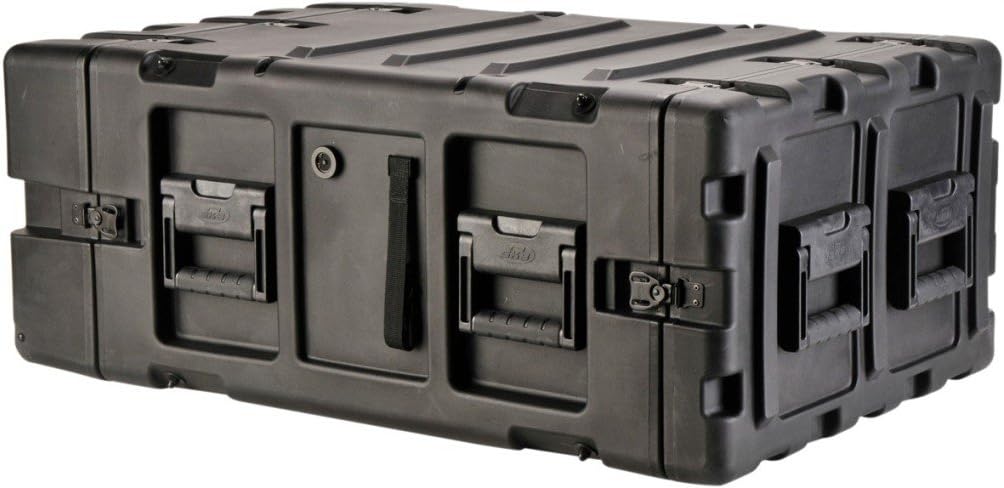
If you’ve ever packed a rack — a metal frame that holds multiple pieces of gear in standardized slots called “rack units” (abbreviated RU or U, where 1U equals 1.75 inches of vertical space) — you already know the anxiety of handing it to a cargo handler. A rack-mounted signal chain is the spine of a broadcast truck, a military communications shelter, or a touring sound system: it holds routers, audio mixers, power conditioners, video switching hardware, and intercom gear, all cabled together and tuned to work as one unit. Pulling that chain apart to transport it individually isn’t practical. The whole rack travels as a system — and when that system costs $20,000 to $60,000, the case around it is the last line of defense against a very expensive insurance claim.
This guide focuses on two of the most-discussed case families in professional broadcast and government contracting circles: SKB’s shock mount rack series and Sound Town’s ATA flight cases. “ATA” refers to the Air Transport Association’s Spec 300 standard — a published specification that defines how a case must be built (materials, hardware, corner construction) to survive repeated airline and freight handling. You’ll get a clear picture of where each family excels, where it compromises, and the decision framework to match the right case to your specific mission profile.
What “Shock Mount” and “ATA 300” Actually Mean for Your Gear
Before you compare price tags, you need to understand what you’re paying for structurally — because the two terms describe entirely different protective philosophies.
ATA 300 Category 1 is a construction standard, not a shock-absorption rating. A case that meets ATA 300 is built from specified materials — typically 3/8-inch or 1/2-inch plywood laminated with high-density polyethylene (HDPE) or aluminum, with recessed hardware and welded steel butterfly latches — and is designed to survive 100 round trips of airline handling without structural failure. Sound Town’s ATA cases, per their manufacturer documentation, follow this framework: heavy-duty tongue-and-groove joints, 9mm or 12mm birch ply cores, and ball-corner hardware rated for stacking loads. They are structurally rugged. They are not, by themselves, shock-isolating.
Shock mounting means the rack frame inside the case is physically decoupled from the case walls using rubber or urethane isolator mounts. SKB’s Roto Molded shock mount racks (the 3SKB-R series) suspend the interior rack rails on isolation hardware that absorbs vibration and impact energy before it reaches your gear. Per SKB’s published product specifications, the isolators are rated for repeated shock loads and are designed to protect sensitive electronics from the impulse forces of airline baggage handling — the kind of 3–5G drop events that can dislodge rack screws, crack solder joints on older analog gear, or corrupt firmware on digital hardware that wasn’t properly seated.
The practical difference: an ATA 300 case protects the rack from outside damage. A shock mount rack protects the gear from forces transmitted through the case. For a chain carrying digital signal processors, RF distribution amplifiers, or military-grade encryption hardware, you often need both layers working together.
SKB Shock Mount Racks: Where the Engineering Budget Goes
SKB’s shock mount rack line divides into two main construction types: the Roto Molded series (injection-molded polyethylene shell, SKB’s signature process) and the Universal Shock Mount plywood cases. The R series Roto racks — 2U through 16U configurations — are the ones operators in long-run reviews consistently flag for extreme-duty transport.
What the published specs tell you:
| Model | Interior RU | Exterior Dims (approx.) | Rated Isolation | Street Price Range (2026) |
|---|---|---|---|---|
| SKB 3SKB-R2U | 2U | 21.5 × 19.5 × 7.5 in | Urethane shock mounts | ~$280–$320 |
| SKB 3SKB-R4U | 4U | 21.5 × 19.5 × 11.5 in | Urethane shock mounts | ~$370–$420 |
| SKB 3SKB-R8U | 8U | 21.5 × 21.5 × 22 in | Urethane shock mounts | ~$550–$620 |
Reviewers at B&H Photo Video Explora note in their broadcast rack buyer’s guide that the Roto shell is the differentiating factor for airline-checked transport: the one-piece molded construction eliminates the seam failures and delamination that plywood cases can develop after years of stacking. The tradeoff is interior depth. SKB’s Roto racks typically offer 14 to 17 inches of usable interior depth behind the rail face — sufficient for most 1U/2U processors and power conditioners, but tight if you’re racking deep 3U broadcast routers or large-format intercom mainframes.
For military and government contractor use, the SKB line carries an additional advantage: SKB’s published documentation confirms that their cases are manufactured in the United States and are available through GSA schedule contracts — a procurement pathway that matters significantly for DoD and federal agency buyers. Operators in government AV contracting circles consistently flag this as a non-negotiable criterion when sourcing fleet quantities.
The shock isolation is not a marketing claim. Sound on Sound’s editorial review of road-ready rack cases notes that urethane isolator mounts measurably reduce the impulse energy transmitted to rack-mounted gear, particularly relevant for analog-to-digital converter cards and vintage outboard gear that lacks the robust PCB construction of modern digital hardware.
Sound Town ATA Cases: When You’re Building Custom and Counting Units
Sound Town occupies a different position. Their ATA flight case line — built to Air Transport Association Spec 300 construction standards per the company’s own documentation — is the choice operators reach for when they need to spec a custom interior, stack cases in a truck bay with precision, or source 8 to 20 identical units for a rental fleet without blowing the per-unit budget.
Sound Town cases are built on birch ply cores with aluminum extrusion edging and recessed steel hardware. They are not shock-mount systems by default — the protection is structural, not isolating. For digital broadcast gear that ships in hard-mounted production racks (switchers, multiviewers, fixed-install signal processors), this is often exactly right: the gear is designed for rigid racking, the case is built to take the abuse, and the cost per unit stays rational at fleet scale.
Where Sound Town gets interesting for practitioners is the custom foam and panel fitment ecosystem. Because their cases follow standard ATA interior dimensions, integrators report strong compatibility with aftermarket custom foam inserts, internal panel rails, and cable management systems from third-party suppliers. For a broadcast production company building a set of five identical flypack racks — portable production systems that break down for air freight and reassemble on location — consistency of interior dimensions across multiple units is worth more than the best shock isolation in a single case.
Sound on Sound’s road-ready rack case overview observes that ATA-rated plywood cases in this category represent the historical standard for live production touring, precisely because the interior can be customized to the exact channel count and depth of the gear being shipped — something molded-shell cases make harder.
The cost math is direct: Sound Town ATA rack cases at comparable RU sizes typically run 30–45% less than equivalent SKB Roto units, per aggregated current market pricing. At a fleet of 10 units, that delta is real money.
The Decision Framework: If X, Then Y
Here’s where the practitioner decision actually lives. The comparison isn’t “which case is better” — it’s “which case is right for this specific mission profile.”
If you are a touring broadcast AV engineer or military signals contractor checking cases as airline cargo: SKB’s Roto shock mount series is the stronger choice. The urethane isolation system addresses the specific failure mode of airline baggage handling — repeated impulse loads — and the molded-shell construction eliminates the seam and latch failures that accumulate on plywood cases over years of checked-baggage cycles. Per SKB’s warranty documentation, their Roto cases carry a lifetime warranty, which changes the total cost of ownership math significantly when you’re depreciating cases over a 5–7 year equipment cycle.
If you are sourcing fleet quantities for a rental house, production company, or broadcast studio: Sound Town ATA cases become rational at 6+ units. The per-unit cost savings fund the custom foam fabrication that makes your rental fleet consistent and professional. The ATA 300 construction standard is sufficient for ground transport, truck loading, and controlled freight scenarios where cases are loaded into padded truck bays rather than thrown into airline cargo holds. B&H Photo Video Explora’s broadcast buyer’s guide flags this distinction explicitly: the transit environment is the primary spec criteria, not the brand.
If your signal chain includes sensitive analog gear, vintage hardware, or high-value RF/encryption equipment: The shock isolation layer is non-negotiable. Run SKB shock mount rails even inside a Sound Town ATA outer shell if budget requires it — the isolation hardware is available as an aftermarket fitment, and the combination of ATA structural protection plus urethane rail isolation addresses both failure modes. Operators who’ve configured hybrid setups along these lines note in long-run reviews that the approach works well for 4U to 8U flypack builds.
If the procurement channel is federal or DoD: SKB’s GSA schedule availability simplifies compliance documentation significantly. That’s not a performance argument — it’s a procurement reality that can determine whether a case gets approved in a contracting cycle or gets kicked back for sourcing justification.
By the Numbers
- 1.75 inches — one rack unit (1U), the universal standard that makes rack gear interchangeable across all case brands
- ATA Spec 300 Category 1 — requires cases to survive 100 airline round trips without hardware or structural failure
- 3–5G — typical impulse shock range for airline baggage handling events, per Air Transport Association documentation on packaging standards
- 30–45% — approximate per-unit cost difference between Sound Town ATA and SKB Roto cases at equivalent RU sizes, based on aggregated 2026 market pricing
The Bottom Line
The SKB vs. Sound Town decision is a transit-environment decision, not a quality decision. Both case families are legitimate tools; they solve different parts of the same problem. SKB shock mount racks are built around the airline cargo scenario, where impulse loads are random and uncontrolled. Sound Town ATA cases are built around the structural integrity requirement that every ATA-compliant case must meet, at a price point that scales for fleet sourcing.
If you are standing in front of a $20,000 signal chain that needs to fly checked baggage on a regional carrier to a remote broadcast site next week, the SKB Roto’s isolation system is the rational choice — the cost of one claim will exceed the cost difference between the two case families many times over.
If you are stocking a rental house with consistent, custom-foam-fitted ATA cases for ground-transport production deployments, Sound Town’s construction quality and price-per-unit math deserves serious consideration.
The gear inside always justifies doing this right. The only question is which version of “right” matches your actual logistics profile.