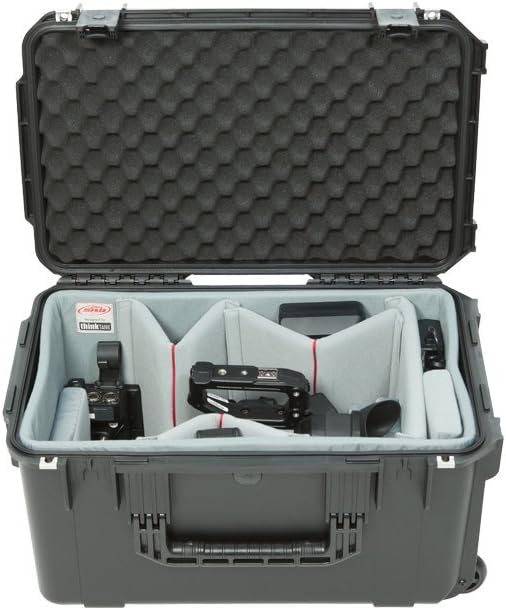
If you’ve spent serious money on a camera rig — a Sony FX3 mirrorless cinema camera, a DJI Mavic 3 Pro drone, or a RED Komodo compact cinema body — you’ve probably already learned the hard way that the soft bag your gear came with isn’t going to cut it on a commercial flight or a job-site van. A hard case is exactly what it sounds like: a rigid outer shell, usually injection-molded plastic, designed to absorb impact and keep moisture and dust out. Inside, most hard cases ship with pre-cut foam or pick-and-pluck foam (a grid of small cubes you tear out to shape a custom cavity). The problem? Once you’ve picked your foam, it’s permanent. If your kit changes — and in broadcast and AV work, it almost always does — you’re stuck cutting new foam or buying a new case.
That’s the gap the SKB iSeries-plus-Think Tank-divider hybrid system is designed to close. SKB (a California case manufacturer with roots in military and touring gear) makes a line of hard cases — the iSeries — with an interior footprint sized to accept standard padded divider sets from Think Tank Photo, a camera bag company whose modular divider systems are designed to be reconfigured in minutes. The result is a hard case with the organizational flexibility of a soft bag. Here’s everything you need to evaluate whether this system fits your workflow.
What the SKB iSeries Actually Gives You (and What It Doesn’t)
The iSeries cases are SKB’s photo and video-focused lineup, distinct from their military and ATA (Air Transport Association) rackmount lines. The key specs, per SKB’s published product documentation, are:
- IP67 waterproof rating — meaning the case is rated to withstand immersion in up to one meter of water for 30 minutes. IP67 is an international standard (IEC 60529) where the first digit (6) means total dust protection and the second digit (7) means temporary immersion. This is the same rating found on Pelican’s mid-tier cases.
- MIL-STD-810G compliance (manufacturer-rated) — a U.S. military test standard for environmental durability including shock, vibration, and temperature. SKB cites this in product literature as applicable to the iSeries line.
- Trigger release latches — spring-loaded, TSA-accepted locking points (you can run TSA-approved padlocks through the latch loops).
- Polypropylene shell — lighter than ABS plastic and comparable in impact resistance for most transit scenarios, per B&H Photo Explora’s hard case buyer’s guide.
What the iSeries does not give you out of the box is a soft-goods interior. Most configurations ship with either layered foam or a pick-and-pluck grid. That foam is serviceable for a static kit, but it doesn’t adapt well to a broadcast cinematographer who runs a Sony FX3 one week and adds a second body or swaps lenses the next.
The other tradeoff: iSeries cases are not the lightest in class. Operators in long-run reviews on DPReview note that while the polypropylene shell saves weight versus aluminum or steel cases, the iSeries 3i-2011-7B (a popular mid-size option) runs roughly 7.5 lbs empty. Add dividers, a body, glass, and accessories and you’re looking at 15–20 lbs in a carry-on footprint. That matters when you’re schlepping through a three-connection travel day.
How Think Tank Dividers Fit (the Compatibility Math)
This is where the system gets interesting — and where you need to do a little homework before buying.
Think Tank Photo’s divider sets — particularly the Artificial Intelligence V3.0 line — are designed around standard interior dimensions that align with several SKB iSeries interior footprints. The AI V3.0 dividers use hook-and-loop (Velcro-style) attachment to base panels, letting you reconfigure compartments without tools. Think Tank’s published divider system documentation specifies divider height, base panel dimensions, and recommended case interior clearances.
By the numbers:
| SKB iSeries Model | Interior (L × W × D, inches) | Compatible Think Tank Divider Set | Carry-On Compliant? |
|---|---|---|---|
| 3i-2011-7B | 20.5 × 11.5 × 7.5 | AI V3.0 Body + Lens (large) | Yes (check airline) |
| 3i-1813-7B | 18.0 × 13.0 × 7.5 | AI V3.0 Body + Lens (standard) | Yes (most carriers) |
| 3i-2217-10B | 22.0 × 17.0 × 10.0 | AI V3.0 + expansion dividers | Checked bag only |
Interior dimensions sourced from SKB published product specs. Carry-on compliance per IATA standard cabin baggage guideline of 21.5 × 15.75 × 7.87 inches; always verify with your specific carrier before travel.
The honest caveat: the divider fit is close but not engineered as a co-designed system. Think Tank and SKB have not published a formal compatibility guarantee. What you’ll find across aggregated DPReview community reports is that users doing this pairing consistently describe a snug but workable fit, with the divider base panels sitting flush against the iSeries interior walls when the correct divider set is matched to the right case interior. The system works — but measure twice before you order.
The Real-World Workflow Case for This Hybrid
Here’s what the system looks like in practice, based on how broadcast cinematographers describe using it in Sound on Sound coverage of gear transit and in Outdoor Photographer’s field guides on case selection.
A typical Sony FX3 broadcast kit for a two-camera interview setup might include: two camera bodies, 3–4 prime lenses (24mm, 35mm, 50mm, 85mm), two cages or rigs, batteries, cards, and a monitor. In a pick-and-pluck foam iSeries, that kit is locked in position — great for transport, slow to access on set. With Think Tank dividers inside the same case, you can pull the top panel, reconfigure compartment widths in under two minutes, and adapt to a run-and-gun single-body setup when the job changes.
The other workflow advantage operators consistently report: the divider sets are replaceable. If you damage a divider panel or upgrade your Think Tank system, you’re not replacing a $300+ case — you’re replacing a $60–$120 divider set. Compared to the cost of re-foaming a case or buying a second case for a different kit configuration, the math tilts clearly toward the hybrid approach for shooters with evolving kits.
Rental houses and small production companies sourcing multiple units find an additional advantage: iSeries cases stack cleanly (flat lid design, consistent exterior dimensions across the line), and Think Tank divider sets can be standardized across a fleet. A coordinator can pull any 3i-2011 from the shelf, drop in the appropriate divider config for that day’s kit, and have it documented in a manifest. SKB’s published warranty on the iSeries is a lifetime guarantee on the shell — relevant for fleet buyers calculating long-term cost per unit.
Where This System Doesn’t Win
Be honest with yourself about a few scenarios where this hybrid doesn’t make sense.
If your kit never changes: A dedicated pick-and-pluck foam setup in the same iSeries case is lighter, cheaper, and offers slightly better per-item immobilization. Custom-cut foam holds lenses more securely against lateral shock than divider-separated compartments, particularly for fast drops or turbulence. B&H Photo Explora’s hard case guide notes that foam-in-shell configurations remain the standard for maximum impact protection of individual items.
If you’re flying international carriers with strict carry-on enforcement: The 3i-2011 sits at the edge of many carriers’ carry-on size policies. Adding Think Tank dividers doesn’t change the external dimensions, but if your airline measures cases at the gate, you’re working without much margin. The 3i-1813 is the safer carry-on bet on stricter routes.
If weight is the primary constraint: Operators who have moved to Pelican Air cases (notably the 1615 Air) for weight savings note that iSeries cases run heavier than the Air line at comparable interior volumes. If you’re on a long-haul touring schedule where checked bag weight fees compound across 40+ travel days, a Pelican Air with aftermarket cubed foam might be a more economical choice over a season than the iSeries-plus-dividers system. Sound on Sound’s coverage of touring engineer gear management touches on this weight-versus-protection tradeoff directly.
If you need true rack integration: SKB’s iSeries is not the same product family as their R Series rackmount cases. If your broadcast setup involves rackmounted recorders, mixers, or outboard gear, the R Series is the relevant line. The iSeries is camera and lens-forward.
If X, Then Y: The Decision Rule
Here’s how to read your situation:
If you’re a broadcast cinematographer or AV engineer with a kit that changes between jobs (different bodies, different lens sets, different accessories per client), and you’re flying domestic routes where the 3i-2011 clears carry-on policy, and you want a system you can reconfigure on the fly without tools — the SKB iSeries with Think Tank AI V3.0 dividers is the hybrid system worth building around. The IP67 shell handles transit; the dividers handle adaptability. The combo sits in the $350–$550 range depending on case size and divider configuration, which is rational insurance for a $10,000+ camera system.
If your kit is static and you fly international routes where carry-on margins are tight — stay with pick-and-pluck foam in the iSeries or look at the Pelican 1510 Carry-On (a narrower footprint that clears most international overhead bin policies). The hybrid adds cost and complexity you don’t need if the reconfigurability isn’t the point.
If you’re sourcing for a rental fleet or production company — the iSeries lifetime shell warranty combined with standardized Think Tank divider sets is a genuine operational advantage. Per-unit cost is secondary to the consistency and the ability to reconfigure inventory without case replacement.
If you’re an enthusiast building your first serious protection setup on a $150–$300 budget — the SKB iSeries plus Think Tank dividers lands above that range. Consider the SKB iSeries 3i-1813 alone with pick-and-pluck foam as a starting point, and plan the divider upgrade when the kit (and the client list) justifies it.
The hybrid system isn’t magic. It’s a rational answer to a specific problem — protecting expensive gear in transit while preserving the flexibility that working broadcast shooters actually need between jobs. If that’s your situation, the math and the workflow both point in the same direction.