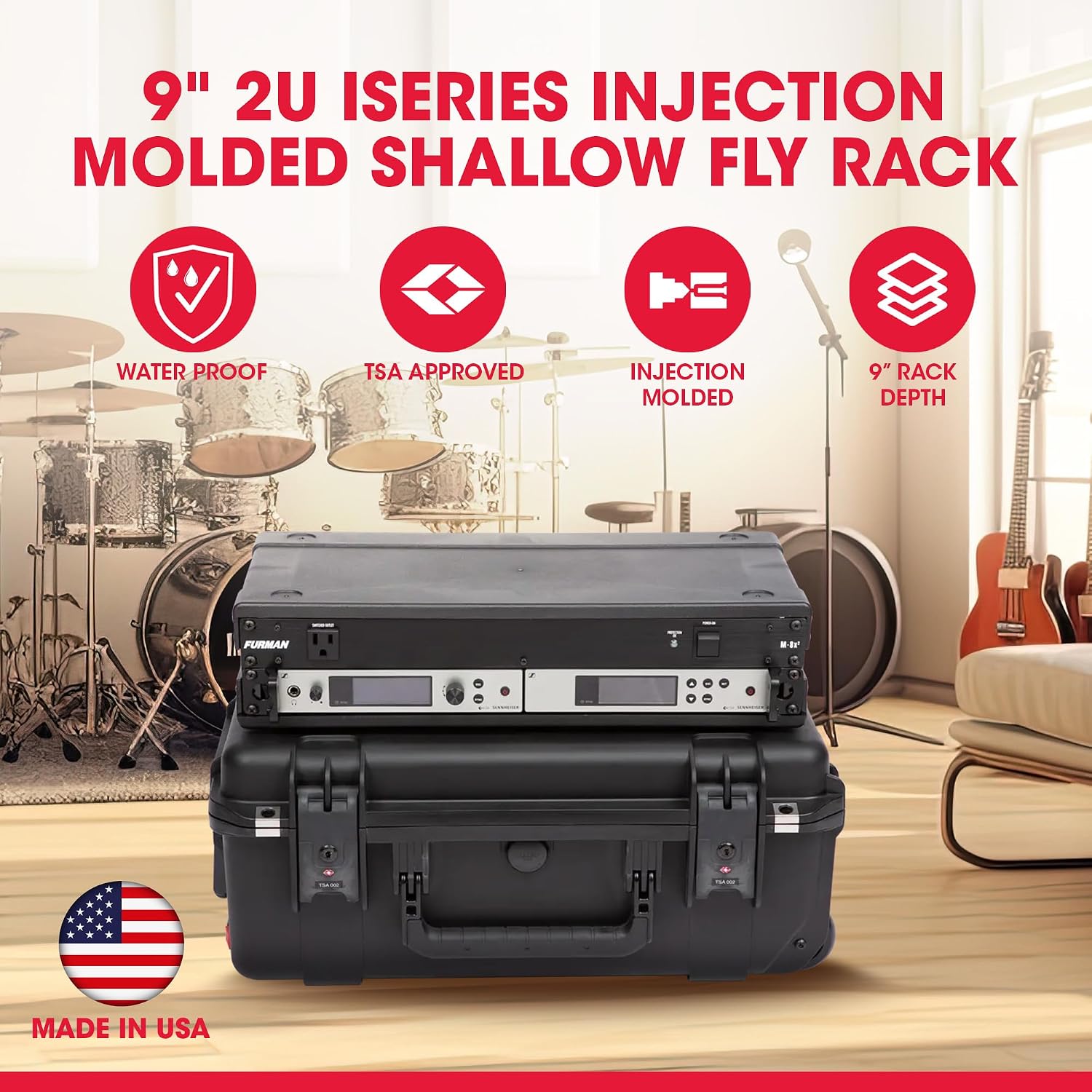
If you’ve ever rolled a rack of audio processors or video switching gear to an airport check-in counter and felt a quiet dread watching the baggage handler toss it onto the belt — this article is for you. A “rack” in AV (audio-visual) terms is a standardized metal frame that holds equipment in uniform-width slots called “rack units” or “U” — one U equals 1.75 inches of vertical space. A “fly rack” is that same equipment packed into a portable case rugged enough to survive airline cargo holds, freight trucks, and the general chaos of touring. The problem most touring engineers hit quickly is that proper rack protection has traditionally meant large, heavy road cases that eat into baggage fees or require freight forwarding. SKB’s iSeries rackmount line tries to solve that with injection-molded polypropylene shells carrying an IP67 rating — meaning the case is completely dustproof and can survive submersion in up to one meter of water for 30 minutes, per SKB’s published specifications. This guide breaks down which iSeries fly rack fits your rig, your airline’s size rules, and your actual budget.
What “IP67 in a Carry-On” Actually Means for Your Workflow
Let’s be precise about the tradeoff you’re accepting when you choose a sealed injection-molded rack case over a traditional plywood road case or an aluminum-panel rack bag.
The upside: IP67 certification, as defined by the IEC 60529 standard and cited in SKB’s product documentation, means the case’s seal is tested to exclude all dust and resist water ingress at one meter depth. For touring engineers working outdoor festivals, wet-dock load-ins, or tropical broadcast locations, that matters in a way that a fabric rack bag simply cannot match. The polypropylene shell also resists dents and cracks better than laminated plywood in airline cargo environments, according to operator observations aggregated in Sound On Sound’s road case feature from March 2024.
The tradeoff: Sealed injection-molded cases add shell thickness and lid-lock hardware that a plywood or ATA-style case doesn’t carry. That shell thickness eats into your usable rack depth and your overall exterior footprint. SKB’s iSeries cases use an industry-standard 19-inch rack rail width internally, but the external dimensions are larger — and that’s where airline compliance gets complicated.
The carry-on question: Most major airlines in 2026 allow carry-on bags up to 22 × 14 × 9 inches (approximately 56 × 36 × 23 cm), though this varies by carrier and aircraft type. SKB publishes exterior dimensions for every iSeries model, and the 2U (two-unit) and 3U versions come closest to overhead-bin compatibility — but “closest” does not always mean “guaranteed.” Aviation Pros’ coverage of baggage rules for AV and broadcast gear notes that gate agents have discretion, and hard-sided cases with protruding latches can be flagged even when the tape-measure dimensions technically comply. The practical takeaway: treat carry-on compliance as a strong possibility with the 2U, a negotiation with the 3U, and a checked-bag scenario with anything larger.
The iSeries Rackmount Lineup: Sizing It Out
SKB’s iSeries rackmount cases are identified by their rack-unit depth and rack space. Here’s the relevant breakdown based on published spec sheets:
By the numbers — SKB iSeries Rackmount External Dimensions (published specs, 2025):
| Model | Rack Space | Ext. L × W × H (in) | Weight (empty) |
|---|---|---|---|
| 3i-R2U-13 | 2U, 13” deep | 21.5 × 17 × 7.5 | ~14 lbs |
| 3i-R3U-13 | 3U, 13” deep | 21.5 × 17 × 9.5 | ~17 lbs |
| 3i-R4U-13 | 4U, 13” deep | 21.5 × 17 × 12.5 | ~21 lbs |
| 3i-R2U-20 | 2U, 20” deep | 27.0 × 17 × 7.5 | ~17 lbs |
Source: SKB Cases iSeries product documentation. Dimensions rounded; confirm with SKB before purchasing for a specific airline route.
The 13-inch-depth models (labeled -13 in the model number) are the workhorses for fly-rack duty. Thirteen inches of usable rack depth is tight — it accommodates most 1U and 2U signal processors, small mixers, patch bays, and wireless receiver racks, but not full-depth amplifiers or large routers. The 20-inch-depth variants open up your gear options but add roughly 5.5 inches to the external length, pushing them firmly into checked-baggage or freight territory.
Here’s what you should consider if you’re loading wireless receiver packs, a small DSP unit, and a fiber converter into a fly rack: the 2U or 3U 13-inch-depth model is your starting point. Most Shure Axient Digital or Lectrosonics rack receiver units are 1U at 12–13 inches deep, which fits the -13 depth with little margin. Plan your gear list before you order the case, not after.
IP67 vs. ATA 300: Why the Rating Difference Matters to You
If you’ve worked in touring long enough, you’ve seen ATA 300 stamped on road cases. ATA 300 (Air Transport Association spec 300) is a structural durability standard — it defines how many drops, vibrations, and compression cycles a case must survive before it’s rated for air freight. It says nothing about water or dust.
IP67 is an ingress protection standard — it defines what gets inside. These are not competing ratings; they measure different things.
SKB’s iSeries cases do not carry an ATA 300 certification. SKB’s published documentation focuses on the IP67 seal and a lifetime warranty. This is the core tradeoff you need to name explicitly before spec’ing these cases for a client or a rental house fleet:
- If your primary threat is environmental — rain at a festival load-in, condensation in a cold arena, dusty outdoor broadcast — IP67 wins. The iSeries will protect electronics that an unsealed road case won’t.
- If your primary threat is structural impact from freight forwarding — a forklift clipping a pallet, cases stacked four high in a cargo net — traditional ATA-rated plywood road cases or SKB’s own ATA series handle that load path differently.
Sound On Sound’s March 2024 road case feature quotes working engineers who use the iSeries specifically for airline carry-on and SUV transport, not for freight palletizing. That’s a meaningful usage signal. B&H Photo’s Explora guide on rackmount case selection similarly positions injection-molded sealed cases as the strong choice for air travel and environmental protection, with ATA-style cases favored for repeated freight shipping and heavy touring truckloads.
Foam, Rails, and the Lid-Cavity Trap
One operator error that comes up repeatedly in aggregated reviews: buyers purchase an iSeries rackmount case expecting to use the lid cavity for cable storage, then discover the lid foam insert compresses their patch cables against gear panels at closure.
SKB’s iSeries rackmount cases include rack rails pre-installed in the shell, a pull-and-tear foam interior for the base, and a separate foam lid insert. Operators report — and SKB’s own documentation confirms — that the lid cavity depth in the 2U and 3U -13 models is limited. You’re looking at roughly 2–2.5 inches of usable lid space before the foam compresses against a flush-mount unit. That’s enough for lightweight cables in a small pouch or a thin power strip, but not for a bundled multipin snake or a heavy loom.
Here’s what you should consider if you’re a monitor engineer flying a 2U wireless rack with a cabled snake return: plan the cable management outside the case lid. A separate soft cable bag that checks separately is more reliable than fighting the lid foam.
Outdoor Photographer’s breakdown of hard case ratings notes that the gasket seal integrity of any IP-rated case degrades faster when users consistently overpack lids against the compression limit of the gasket. That’s worth taking seriously for a case you’re checking 40 times a year.
The Fleet and Rental House Equation
If you’re sourcing multiple units for a rental house or a small broadcast studio, the iSeries rackmount cases present a stackability question that plywood cases solve more naturally.
SKB’s injection-molded shells have a slight taper at the base and a recessed lid that allows stacking, but operators working in flight case rental note that the stacking stability of iSeries cases is reliable for two-high but less predictable for three-high without strapping — particularly for the 3U and 4U variants. Per-unit pricing for the iSeries 2U 13-inch model has been running in the $350–$450 range depending on the distributor and order volume as of early 2026, per SKB’s published MSRP guidance and standard distributor margins.
For a rental house sourcing ten units: the lifetime warranty (SKB’s published policy covers defects in materials and workmanship for the life of the product) reduces long-term replacement cost meaningfully versus a plywood road case with a finite structural life. The consistency of the injection-molded shell — every unit is dimensionally identical — matters for rack hardware compatibility across a fleet. An ATA plywood case built by two different shops to the same spec will have small dimensional variances; an injection-molded case won’t.
Here’s what you should consider if you’re managing a fleet of 8–12 fly racks for a regional broadcast rental house: the iSeries lifetime warranty and dimensional consistency justify the per-unit cost over plywood alternatives. If you’re running frequent freight-pallet shipping rather than airline carry-on, evaluate SKB’s ATA rack series alongside the iSeries before committing the fleet.
The Decision Rule
Pull this out and keep it:
-
If you fly your rack as carry-on 10+ times per year and work wet or dusty environments: The SKB iSeries 2U or 3U 13-inch-depth model is the correct case. The IP67 seal does real work, and the carry-on dimensions are achievable with the 2U. Budget $380–$450 per unit.
-
If you fly checked baggage and your primary gear threat is environmental: iSeries 4U or the 20-inch-depth variants expand your loadout without compromising the seal. Expect $480–$600 per unit at standard distributor pricing.
-
If your primary threat is freight-pallet shipping and structural impact rather than water/dust: The iSeries is not optimized for you. Look at SKB’s ATA rack series or traditional plywood road cases built to ATA 300.
-
If you’re a monitor engineer or FOH engineer with a wireless-heavy rack that needs to survive a festival season including outdoor dates: The iSeries is doing the work no rack bag can do. The IP67 seal is not a marketing claim — it’s a tested ingress protection rating defined by IEC 60529, per SKB’s documentation. That seal earns its keep the first time your rack sits in a rain-soaked stage wing.
The fly rack decision isn’t glamorous, but getting it wrong means a $12,000 wireless system sitting in a case that filled with condensation overnight. The iSeries exists to make that scenario not your problem.