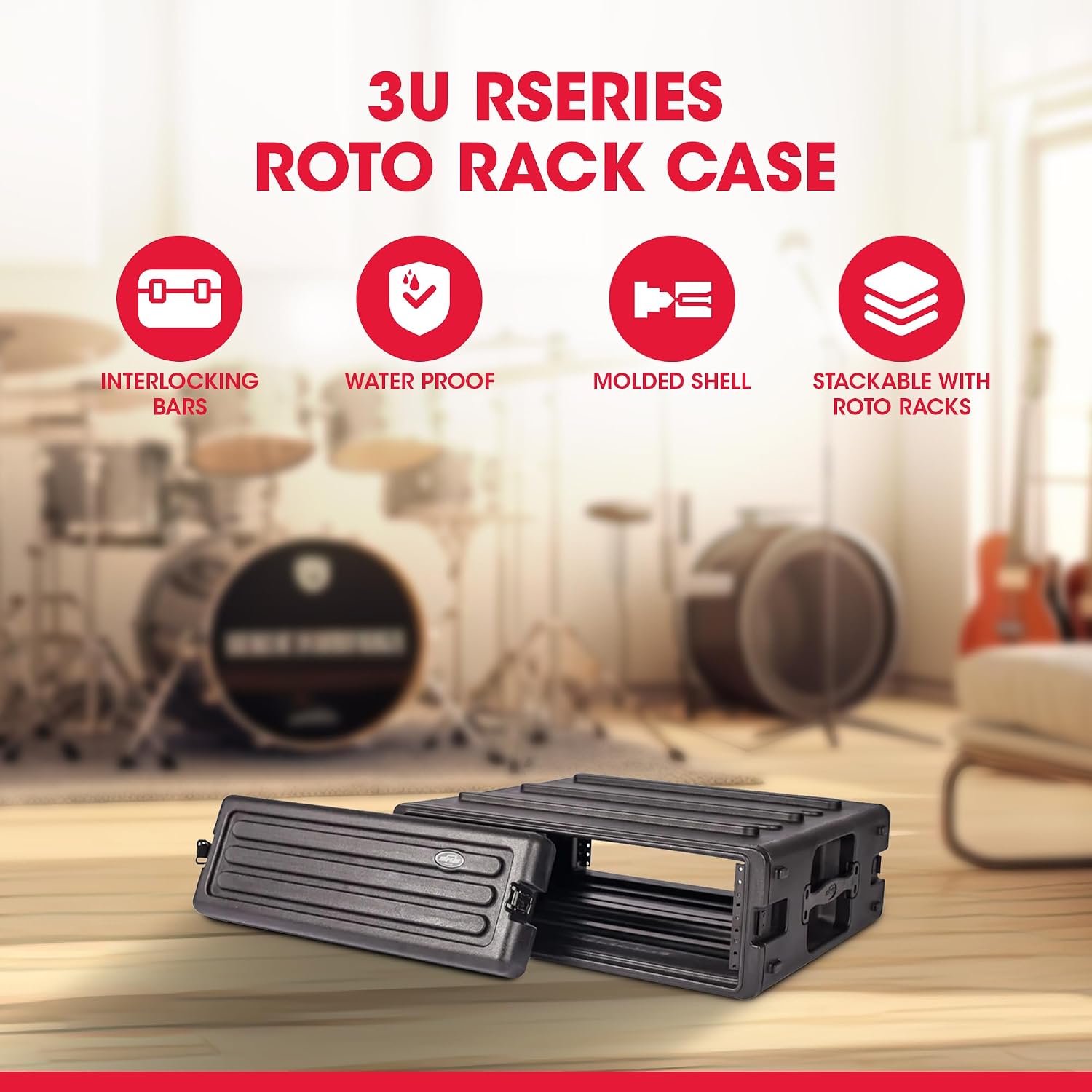
If you’ve ever watched a touring sound engineer wheel a boxy, latched case onto a stage and wondered what’s inside — that’s a rack case. A rack case is a purpose-built hard-shell container with horizontal mounting rails on the inside, spaced to hold industry-standard rack-mounted gear (audio processors, power amplifiers, wireless receivers, video routers, and similar equipment). The spacing standard is called “U” or “rack unit,” where 1U equals 1.75 inches of vertical mounting height. A 4U case holds four of those slots; a 12U holds twelve. SKB’s Roto Rack line is one of the most widely used families in live AV, broadcast, and DJ touring because the shell is rotationally molded polyethylene — meaning the plastic is one continuous piece, with no seams to crack under repeated transport. This guide will help you figure out exactly which Roto Rack size fits your gear, your trunk, and your budget — without paying for empty space you’ll never fill.
| EDITOR'S PICK[SKB 4U rSeries Rolling Rack wit…](https://www.amazon.com/dp/B07FWDBC1L?tag=greenflower20-20) | Mid-tier[Gator Cases Lightweight Molded…](https://www.amazon.com/dp/B0002BG4O8?tag=greenflower20-20) | Budget pick[SKB 3U Roto Rack Case - Durable…](https://www.amazon.com/dp/B01LEGK6CK?tag=greenflower20-20) | |
|---|---|---|---|
| Rack Units | 4U | 6U | 3U |
| Depth | — | 14.25" | — |
| Wheels | ✓ | — | — |
| Stackable | ✓ | — | ✓ |
| Waterproof | — | — | ✓ |
| Price | $324.99 | $259.99 | $224.99 |
| See on Amazon → | See on Amazon → | See on Amazon → |
Why “U Count” Is Only Half the Equation
Most buyers get the U count approximately right on the first try. They count their gear slots, add a spare U or two, and order. Where the math quietly goes wrong is depth — and depth mistakes are expensive, because they usually mean buying a second case.
Rack depth is measured from the front mounting rail to the rear wall of the case interior. SKB publishes interior depth specs for each Roto Rack model, and the numbers matter because different gear has wildly different depth profiles:
By the numbers — common rack-gear depth requirements (manufacturer-spec sources):
| Gear Type | Typical Depth Needed |
|---|---|
| 1U patch panel or passive DI | 4–6 inches |
| Wireless receiver (Shure, Sennheiser) | 7–9 inches |
| Power amplifier (Crown, QSC) | 14–18 inches |
| Video router / broadcast switcher | 12–20 inches |
| Blank filler / 1U shelf | 2 inches |
SKB’s Roto Rack shallow models (the 1SKB-R4S and 1SKB-R6S, for example) run interior depths around 13–14 inches. Their standard-depth models push to roughly 17–18 inches interior. Their deep “tour” variants reach 21 inches or more. Per SKB’s published spec sheets, the distinction between shallow and standard depth is called out explicitly in the model suffix — “S” for shallow in the consumer-DJ-oriented line, no suffix or “U” for the standard/deeper units in the touring line.
The guidance from B&H Photo Video Explora’s rack case buying resource is direct on this point: measure your deepest piece of gear from the front rack ear to the rear panel, add at least 1.5 inches for cable management at the back, and that sum is your minimum interior depth requirement. Buying shallow to save weight and then discovering your amplifier won’t physically close inside is a mistake operators across ProSoundWeb community discussions describe as a near-universal rite of passage.
The SKB Roto Rack Model Family, Mapped
SKB’s Roto Rack lineup is larger than most buyers realize. Here’s how to navigate it without drowning in SKU numbers.
Shallow-Depth DJ and AV Roto Racks (roughly 4U–12U, ~13–14” interior depth)
These are optimized for gear with short depth profiles — mixers, wireless systems, and signal processors that don’t extend far behind the rack ear. They’re the lightest option in the Roto Rack line and the most airline-friendly when flying carry-on restrictions are in play (though you’ll want to verify airline dimension limits for your specific route — SKB’s spec sheets list exterior dimensions, and TSA acceptance is separate from airline carry-on sizing).
Here’s what you should consider if you are a mobile DJ running a 4–6U setup with a digital mixer, a two-channel audio interface, and a wireless mic receiver: the shallow rack keeps total case weight under 30 lbs loaded, which matters when you’re setting up solo. Adorama’s Learning Center rack essentials guide notes that shallow racks are ideal when no single piece of gear exceeds 12 inches in depth.
Standard-Depth Roto Racks (roughly 4U–16U, ~17–18” interior depth)
This is the workhorse tier — the range where most live sound engineers, broadcast AV contractors, and touring musicians land. Standard depth accommodates power amps in the 14–16 inch range, which covers the QSC GX series and Crown XTi line that populate most mid-tier touring rigs.
Sound On Sound’s rack case buyer’s guide consistently points to the 8U–12U standard-depth configuration as the “production-ready sweet spot” for a touring keyboard or vocal processor rig — enough U space to add a power conditioner and a spare channel of wireless without building a second case.
Deep Tour-Grade Roto Racks (roughly 8U–24U, 20”+ interior depth)
These are the cases you see on arena stages and broadcast truck decks. They accommodate large-format power amps, redundant signal chains, and the kind of gear depth that only shows up in serious permanent rigs. Per SKB’s specification documentation, some deep tour models include recessed hardware to keep the exterior footprint TSA-compliant for checked-baggage transport, though at the heaviest end of the line (24U loaded), air freight rather than checked bags is the realistic transport method.
Here’s what you should consider if you are a production company building a fleet of identical touring racks: the deep tour models offer a stackability advantage. SKB engineers the Roto Rack lids with a consistent external profile, which means cases of the same footprint stack securely on flat-bed trucks without lateral movement. Per conversations documented in ProSoundWeb operator threads, rental houses running SKB fleets specifically cite this consistency as a procurement reason — uniform footprint across U counts simplifies staging logistics.
The Three Mistakes That Lead to Overspending
1. Buying Up in U Count “Just in Case”
Empty rack U is not free. Every extra U is weight and exterior volume. Weight matters for airline checked-bag fees (most carriers cap checked bags at 50 lbs before overweight surcharges kick in — SKB’s heavier Roto Racks can reach 25–35 lbs empty before you load gear). Exterior volume matters for vehicle cargo space and for compliance with venue rack-bay dimensions. The guidance from Adorama’s Learning Center is practical: buy for your current gear stack plus two spare U. Resist the urge to spec for a hypothetical expansion that may never happen.
2. Ignoring Rail-to-Rear-Wall Clearance vs. Total Interior Depth
These are related but not identical numbers. SKB’s spec sheets list interior depth as the measurement from the front of the case to the rear wall. But your gear mounts on rails, and the rails themselves sit inside the front lip of the case — typically 1–2 inches back from the front edge. That means your usable clearance from the rear of a rack-mounted unit to the rear wall is interior depth minus the rail setback. B&H Photo Video Explora’s rack case guide flags this measurement specifically: if your power amp is 16 inches deep and the interior depth is 17.5 inches with a 1.5-inch rail setback, you have exactly zero cable management room. The safe formula is: your deepest gear + 1.5 inches minimum cable clearance ≤ interior depth minus rail setback.
3. Treating All Roto Racks as Equivalent for Air Travel
They’re not. SKB markets certain Roto Rack models as airline-compliant checked luggage, and others as ground-transport or freight cases. The distinction lives in two places: exterior dimensions (checked-bag linear inch limits vary by carrier but commonly sit around 62 linear inches for standard fare classes) and the hardware profile. Recessed latches and handles keep exterior dimensions predictable and prevent handles from shearing under conveyor belt handling. If air travel is part of your workflow, cross-reference SKB’s published exterior dimensions against your primary carrier’s checked-bag dimension policy before ordering — don’t assume.
The Decision Framework: If X, Then Y
The math points to a straightforward set of rules. Use these as your filter before you click purchase:
If your deepest piece of gear is under 12 inches and your stack is 4–8U: Look at the shallow-depth Roto Rack in the appropriate U count. You’ll save weight and the case will fit in more vehicles. Add two spare U to your count.
If your deepest piece of gear is 13–16 inches or you’re running any power amplifier: Step up to standard-depth. Shallow won’t close cleanly. Add 1.5 inches to your deepest gear’s depth to confirm standard-depth spec covers you.
If you’re running a full PA amplifier rack, broadcast signal chain, or redundant system that exceeds 16 inches of gear depth: You’re in deep tour territory. Weigh the case empty before loading — if you’re approaching your airline’s 50 lb checked-bag threshold with an empty case, budget for freight or plan on ground transport only.
If you’re a production company or rental house buying multiple units: Standardize on one footprint. The stackability benefit of a consistent exterior profile pays dividends over years of transport. Per SKB’s fleet purchasing documentation, volume pricing tiers exist for multi-unit orders — worth a direct call to their dealer network if you’re sourcing five or more units.
If your budget is the primary constraint: The SKB Roto Rack line sits roughly in the $200–$600 range depending on U count and depth, based on current market pricing as of mid-2026. For a 6U standard-depth unit, you’re typically looking at the $250–$320 range at authorized dealers. That price point covers a rack protecting $10,000–$40,000 in gear — Sound On Sound’s rack case analysis frames this exactly right: the case cost is a rounding error against the replacement cost of what’s inside.
One More Thing Worth Saying
Rack cases are not glamorous. They sit in corners, they get loaded last, and nobody photographs them for the ‘gram. But the pattern across every operator review and touring community discussion is consistent: the professionals who’ve lost gear to a crushed transit case once never skip the proper case budget twice. SKB’s Roto Rack line earns its recurring appearance in rider specs and rental inventories not because it’s the cheapest option, but because it has a documented track record of arriving intact. Get the U count right, get the depth right, and don’t buy space you won’t use. That’s the whole framework.